

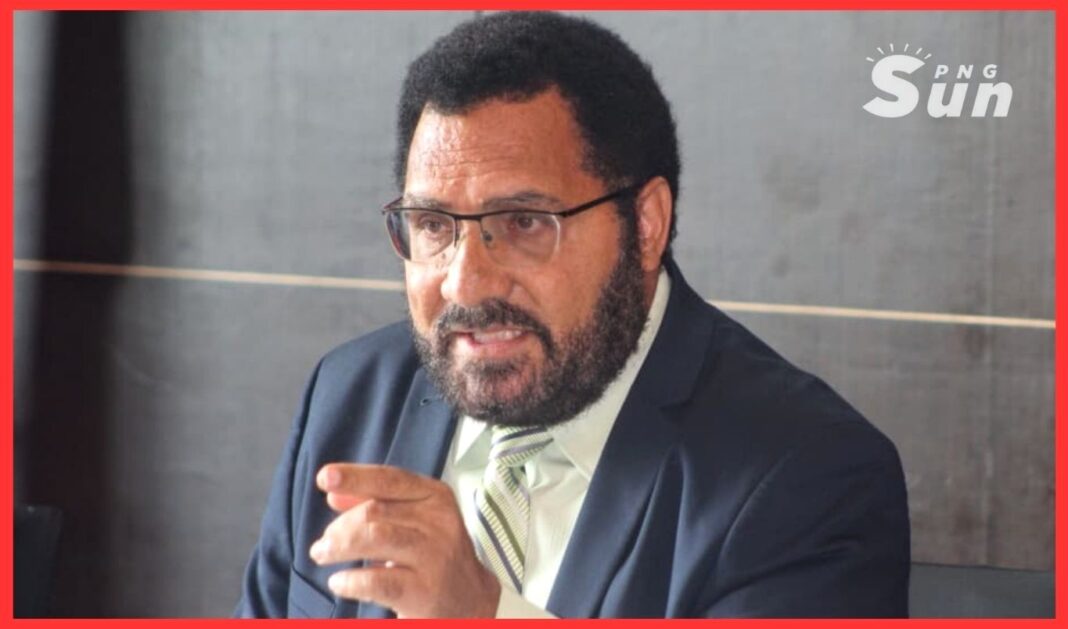

Police Minister Sir John has identified border security as a key national priority, announcing plans to urgently engage regional partners to strengthen border patrols and surveillance in response to rising concerns over illegal guns, drugs, and cross-border crime.
Speaking during his first press conference at the Stanley Hotel in Port Moresby yesterday, Sir John said he would begin consultations within the next two to three weeks with fellow ministers, strategic partners, and neighboring countries to address weaknesses in Papua New Guinea’s border security framework.
The minister said he would first consult domestically with the Minister for Defence before engaging PNG’s strategic partners and donors, particularly Australia, with whom it already works under established development and security partnership arrangements.
Minister Pundari said discussions with Australia and other partners would focus not only on resourcing the Royal Papua New Guinea Constabulary, but also on expanding existing cooperation to improve police performance and operational capacity.
He said regional engagement would also extend to counterparts in Indonesia and the Solomon Islands, describing such consultations as critical to addressing shared security challenges.
“It is not only about resources,” he said. “It is about improving our border security-border patrols and border surveillance.”
The minister warned that weak border controls have contributed to the influx of illegal firearms, ammunition, and drugs into the country, with PNG increasingly becoming vulnerable to transnational criminal activity.
“All these illegal guns and drug trades are happening because of our weakness in addressing border surveillance and border security,” he told reporters.
Minister Pundari said stronger border protection was essential to ensuring public safety and restoring confidence among citizens, noting that illegal trade was not limited to guns and drugs but also included other activities occurring without the visibility of Customs, Migration, and other enforcement agencies.
He called for a coordinated, whole-of-government and regional approach involving the police, Customs, Migration, the Papua New Guinea Defence Force, and international partners, as well as neighboring countries.
“We have to aggressively talk about protecting our borders,” he said, adding that many illegal firearms and ammunition circulating in the region have entered through poorly monitored borders.
Sir John said while police accommodation and logistical support remain important, securing the nation’s borders must take precedence to ensure Papua New Guineans feel safe and protected.
He confirmed that over the coming weeks, his immediate focus would be consultations with strategic partners, development allies, and regional counterparts in Australia, Indonesia, and the Solomon Islands to strengthen cooperation on border security and surveillance.