

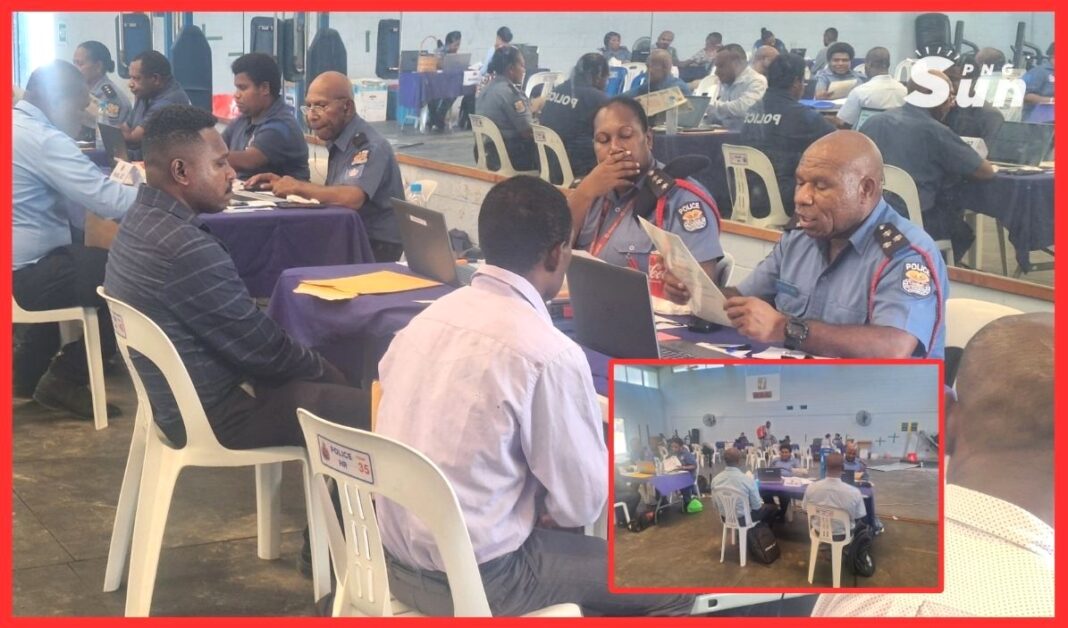

The Royal Papua New Guinea Constabulary has announced an additional recruitment drive at the Bomana National Centre of Excellence in the National Capital District, increasing the number of recruits entering police training as part of broader law and justice reforms.
The Constabulary said the opening of new infrastructure at Bomana has allowed management to increase the intake per training batch from 300 to 500 recruits.
Read previous article on: https://www.postcourier.com.pg/png-aims-for-10000-police-by-2030-26000-in-a-decade-as-law-and-order-top-priority/
“This expansion supports the National Government’s commitment to grow the police force to 10,000 personnel by 2030,” the RPNGC said, adding that from 2026 onwards, intake numbers are expected to rise further to about 700 recruits per batch.
According to the RPNGC, a public call-out in December 2025 invited applicants from NCD, Central and Gulf provinces.
A total of 7,696 applications were received through the online recruitment portal, with 2,711 applicants shortlisted.
The Constabulary noted that unsuccessful applications were largely due to missing documents, low grades in Mathematics and English, age ineligibility, or failure to meet recruitment standards.
“The shortlisted applicants will now undergo the full recruitment process to determine eligibility for the additional intake,” the RPNGC said.
Successful candidates will join the second batch of 2025 recruits from the Highlands and New Guinea Islands regions, with police training scheduled to commence in April 2026.
The Constabulary clarified that, due to time constraints, this recruitment drive is limited to NCD, Central and Gulf provinces, with a separate nationwide call-out for 2026 recruitment to be announced later.
Of the 2,711 shortlisted applicants, 2,086 are from NCD, 463 from Central, and 162 from Gulf Province. Recruitment activities for NCD candidates began on Monday, 9 February 2026, at the Bomana NCoE and are expected to conclude by the end of the week before teams move on to Central and Gulf provinces.
The recruitment process includes screening and validation, literacy and comprehension testing, interviews, medical examinations, practical training tests, and character reference checks.
The RPNGC reported that from the 2,086 NCD applicants, only 1,638 attended screening and validation, while 448 failed to appear. Following document checks, 518 candidates were removed for reasons including lack of a National Identification card, submission of fake documents, or failure to meet height requirements.
“It was also discovered that nine candidates presented falsified documents,” the Constabulary said, adding that the applicants identified small printing companies and individuals allegedly involved in producing the forgeries. “Police will investigate and pursue criminal charges against those responsible. All fake documents were confiscated, and the applicants were cautioned and dismissed from the process.”
To strengthen the integrity of future recruitment drives, the RPNGC said it will engage Criminal Investigation Detective Teams to investigate and charge applicants who submit fraudulent documents, reminding the public that producing fake documents is a criminal offence.
So far, 1,120 candidates have passed the screening and validation stage and have sat for the entry test, with successful candidates progressing to interviews currently underway.
The Constabulary also highlighted efforts to promote equal employment opportunities, including provincial awareness tours and walk-in application support sessions to assist applicants with online submissions, especially in areas with connectivity challenges.
“To reach more people, particularly in rural communities, the Recruitment Team will continue visiting provinces and districts nationwide,” the RPNGC said, noting that outreach has already begun in Gulf and Central provinces.
A nationwide call-out for the 2026 Police Recruitment, covering both Regular Police Training and Police Cadet Training, is scheduled to be advertised in May 2026.