

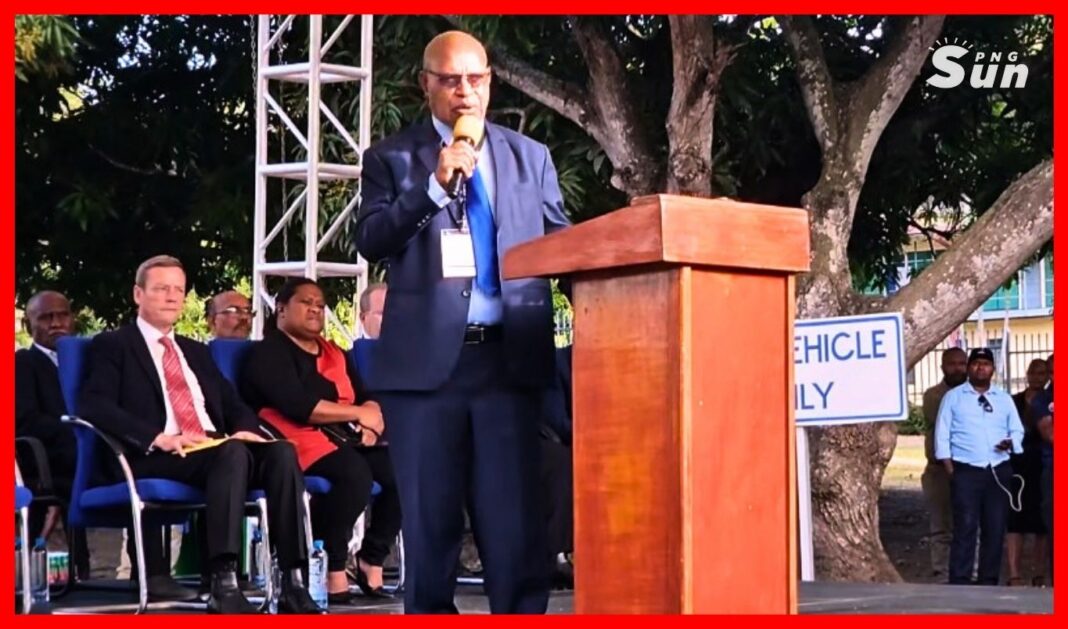

Minister for PNG Power Richard Maru has pledged sweeping reforms to restore the financially troubled state-owned utility, saying his immediate priority is to return the company to profitability and improve electricity services across the country.
Speaking during the handover ceremony at PNG Power headquarters in Port Moresby on Monday, Minister Maru said he was taking over a company in an insolvent position, with debts of K1.2 billion while only K400 million was owed to the utility.
Amongst the reforms planned are revision of Independent Power Producer agreements, the current tariffs which are among the highest in the world, cutting down on expenditures, reduce the liabilities, debt servicing, stop recruitment of expatriate consultants, penalize users over power thefts, public-private partnerships to improve power generation capacity and handful staff getting ‘side money’ from customers.
He rubbished social media claims that he was appointed for one job and that is to pay Dirio Power’s outstanding payments.
He clarified that his job is salvage the company, adding he has no selfish interest in the company.
“We have to get this company out of insolvency, stop the blackouts and reduce the cost of power. PNG Power has the potential to become a company all Papua New Guineans can be proud of,” he said.
Minister Maru said restoring the company’s financial stability would be his first priority, including pursuing a court-approved debt settlement arrangement.
He revealed that PNG Power loses about 26 per cent of its electricity through power theft, technical losses and ageing infrastructure, describing the losses as a major obstacle to the company’s recovery.
The Minister acknowledged the work of former minister William Duma, particularly improvements to the national transmission network, but said further reforms were needed to modernize the country’s electricity sector.
Minister Maru also announced a review of all Independent Power Producer (IPP) agreements, saying some contracts were financially unsustainable because PNG Power was buying electricity at prices higher than it could recover through customer tariffs.
He said the utility was also losing about K70 million each year operating many of its B and C centers, with their future to be reviewed as part of the reform programme.
Among his priorities over the next eight months are reducing the company’s debt, cutting electricity losses, strengthening cost controls, tackling theft and corruption, and preparing PNG Power’s profitable business units for partial privatisation to attract private investment.
Minister Maru said he would not support further borrowing from international financial institutions to recapitalise the utility, arguing that government funds should instead be directed towards essential services such as health and road infrastructure.
He also pledged to strengthen accountability by introducing technology, including artificial intelligence, to detect electricity theft, fuel theft and other fraudulent activities.
Calling on staff, management and the board to support the reforms, Minister Maru said difficult decisions would be required to restore PNG Power’s financial health.
He said a stronger and more efficient PNG Power would help lower electricity costs, support investment in hydropower and contribute to Papua New Guinea’s long-term economic growth.