

Papua New Guinea has moved a step closer to Parliament deciding the political future of Bougainville after Prime Minister James Marape and Autonomous Bougainville Government President Ishmael Toroama concluded the final constitutional consultations on the 2019 Bougainville Referendum on Tuesday.
The Joint Supervisory Body (JSB) meeting at Melanesian Haus yesterday endorsed the Joint Consultation Report (JCR) and the Melanesian Framework, clearing the way for the referendum results to be formally tabled in the National Parliament on August 27, 2026, where Members of Parliament will debate and make a decision in accordance with the Constitution.
The milestone follows years of political debate and public commentary over the constitutional pathway after Bougainvilleans voted overwhelmingly for independence in the 2019 referendum.
While about 97.7 per cent of voters supported independence, the Constitution requires consultations between the National Government and the Autonomous Bougainville Government before the National Parliament makes the final decision.
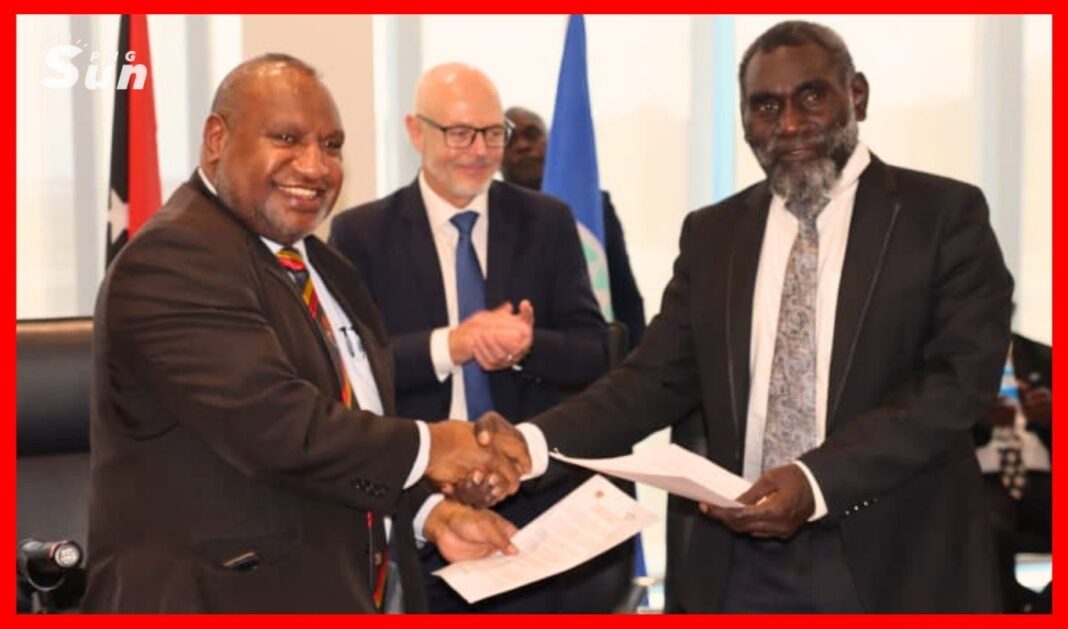
Prime Minister Marape and President Toroama signed the JSB resolutions, witnessed by Bougainville Affairs Minister Manasseh Makiba and ABG Vice President and Attorney-General Ezekiel Masatt.
Prime Minister Marape said the successful conclusion of the consultation process marked an important milestone in Papua New Guinea’s nation-building journey and fulfilled the constitutional requirements under the Bougainville Peace Agreement.
“This is a process that began with the Bougainville Peace Agreement in 2001. It became part of our Constitution. The Constitution required that a referendum be held, consultations take place, and that the National Parliament make the final decision,” he said.
PM Marape said the Government had faithfully discharged all of its constitutional responsibilities under the Peace Agreement and the Constitution, with the JSB recognizing that the consultation requirements under Section 342 had now been completed.
He said Parliament must now be allowed to exercise its constitutional responsibility independently.
“The National Government and the National Parliament are two separate institutions. Government has completed its constitutional responsibilities. Parliament must now undertake its constitutional responsibility.
“Every Member of Parliament will have the opportunity to speak. Every Member will then stand and cast his or her vote according to conscience, guided by the Constitution and the interests of our country.”
The Prime Minister urged Papua New Guineans and Bougainvilleans to respect the parliamentary process and continue engaging peacefully.
“This is a difficult relationship, but it is a family relationship. Dialogue must continue.”
Mr. Marape said Parliament’s decision would not mark the end of the relationship between Papua New Guinea and Bougainville, with both governments committed to continuing discussions on the way forward after Parliament has spoken.
He welcomed the endorsement of the Melanesian Framework, describing it as a jointly developed pathway to guide future engagement, maintain peace and reconciliation, and ensure the orderly implementation of whatever decision Parliament reaches.
The Prime Minister also commended President Toroama, Vice President Masatt, the Joint Technical Team, ministers and officials from both governments, as well as previous leaders and international partners, for their commitment to maintaining peace throughout the consultation process.
Apart from the referendum process, the JSB also agreed to strengthen Bougainville’s fiscal autonomy by progressing the transfer of 100 per cent of revenue generated within Bougainville from fisheries, mining, forestry, land and other relevant taxes by December 31, 2026, while accelerating the transfer of outstanding constitutional powers to the Autonomous Bougainville Government.
PM Marape said the measures demonstrated the National Government’s commitment to fully implementing the Bougainville Peace Agreement.
He also noted that Parliament would consider the referendum results on August 27, immediately after Papua New Guinea’s National Day of Prayer and Repentance on August 26 and called on churches and citizens to pray for wisdom, unity and peace.
PM Marape said Papua New Guinea had demonstrated that even the most difficult national questions could be resolved peacefully through constitutional democracy.
“For twenty-five years we have honoured the Bougainville Peace Agreement through dialogue, patience and constitutional process. Whatever the outcome, let history record that Papua New Guinea and Bougainville chose peace over conflict, dialogue over violence, and constitutional democracy over division.”