

The Centre for Excellence in Financial Inclusion (CEFI) and The Leprosy Mission Papua New Guinea (TLM-PNG) have formalized a new partnership aimed at improving financial literacy and inclusion among vulnerable communities across Papua New Guinea.
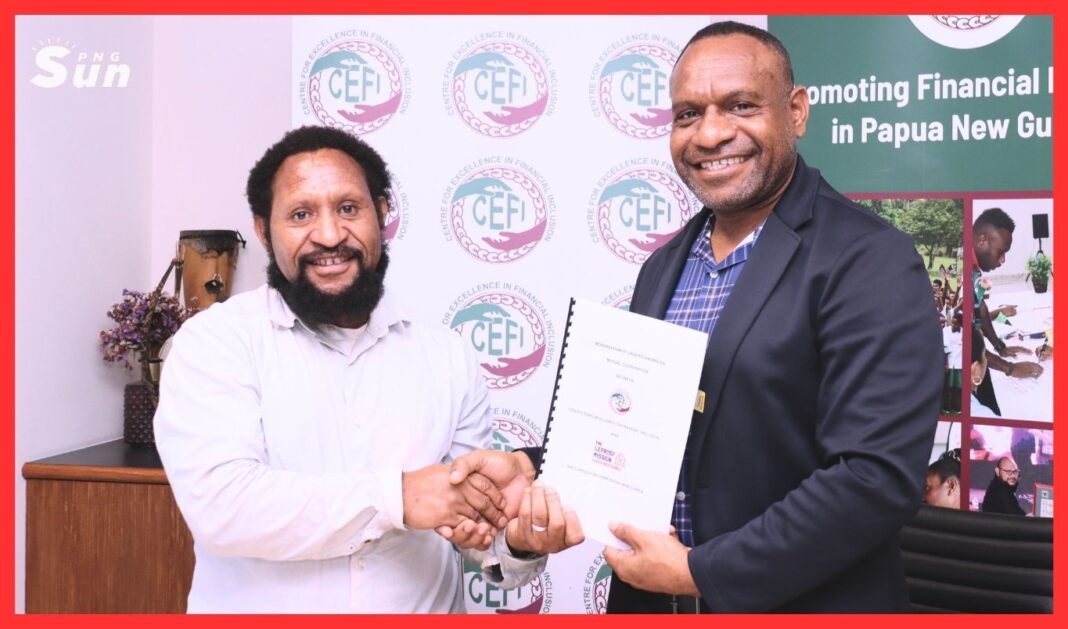
The two organizations have signed a Memorandum of Understanding (MoU) recently at the CEFI office in Port Moresby.
The agreement establishes a collaborative framework for delivering financial literacy training and related financial inclusion initiatives over the next three years.
Under the partnership, CEFI will provide financial literacy training for 25 TLM-PNG staff and key volunteers who are actively involved in community-based development programmes.
The training will support projects where financial capability is essential, including the Preventive Health and Community Empowerment (PHACE) programme; the Sustainable, Active, Fearless and Empowered (SAFE) Communities initiative; the Kominiti Assistance Package (KAP); Climate Change Resilience (CCR); and crab farming projects.
In addition, the programme aims to reach at least 500 community participants over the three-year period of the MoU through community-based retail financial literacy training.
Speaking during the signing ceremony, CEFI Acting Executive Director, Mr. Peter Samuel, described the partnership as an important milestone for the organization.
He said the collaboration marks the first time CEFI has entered into a formal partnership with a health-focused organization working directly with marginalized communities.
Mr. Samuel noted that CEFI has traditionally partnered with financial institutions but emphasized that financial inclusion must extend beyond the financial sector.
“For us, this is a very unique partnership because we have mainly focused on traditional partners such as financial institutions. However, our agenda—and even our name—speaks about financial inclusion,” he said.
He added that the concept of inclusion must recognize organizations that work with individuals who are often excluded from mainstream systems and services.
“The word ‘inclusion’ should not exclude other agencies that play a critical role in supporting people who are marginalized,” Mr. Samuel stated. “Your organization empowers groups of people who are often outcasts in society or overlooked by institutions.”
Mr. Samuel also encouraged both organizations to ensure the partnership translates into meaningful action and tangible results for communities.
“Let us not just sign the MoU and put it aside,” he said. “We must share our work programmes and find ways to collaborate so that the partnership delivers real outcomes for the communities we serve.”
Senior Programme Manager for PHACE, Mr. Larson Nea Yambe, welcomed the partnership and expressed appreciation for CEFI’s support in strengthening the organization’s community empowerment initiatives.
Mr. Yambe explained that while TLM-PNG primarily focuses on health programmes related to leprosy detection, treatment, and patient support, the organization is increasingly integrating livelihood and empowerment initiatives to address poverty and social exclusion.
He noted that programmes such as the SAFE initiative aim to equip vulnerable individuals, including those affected by leprosy, with literacy skills and livelihood opportunities so they can become self-reliant.
“We want to see projects that empower people so they can sustain themselves,” he said.
Mr. Yambe also acknowledged that TLM-PNG does not have the technical expertise to deliver financial literacy training independently, making the partnership with CEFI particularly valuable.
“We are a health organization, and we don’t have the capacity or expertise to facilitate financial literacy training,” he said. “Thank you very much for accepting us and agreeing to sign this MoU.”
Through the partnership, CEFI will also provide complementary support to strengthen financial inclusion within TLM-PNG programmes, including promoting digital personal banking and facilitating bank account openings for community participants during or immediately after financial literacy training sessions.
Both organizations expressed confidence that the collaboration will contribute to improved financial capability, stronger livelihoods, and greater social inclusion for vulnerable communities across Papua New Guinea.