

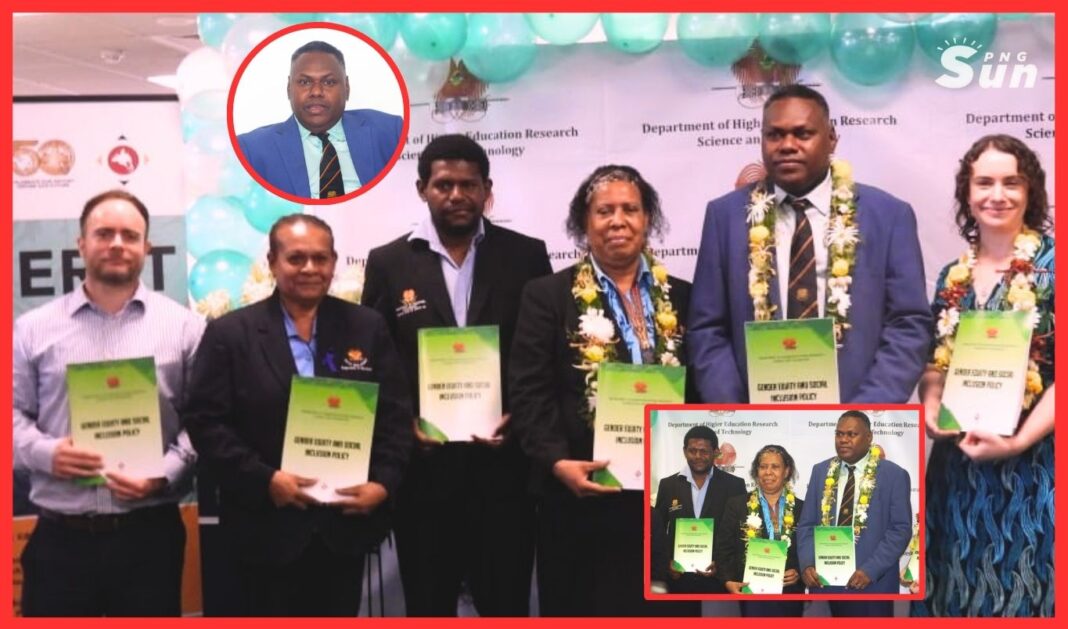

The National Department of Higher Education, Research, Science and Technology (DHERST) officially unveiled the Gender Equality and Social Inclusion (GESI) Policy in Port Moresby on Monday.
It is a policy that was first ordered by the government in 2013.
Related news: https://thepngbulletin.com/news/dherst-launches-gesi-policy/
The launch ceremony was held on Monday 13th April in Port Moresby to demonstrate the department’s leadership commitment to implementing the National Government’s policy.
The GESI Policy was launched and grounded in values of honesty, social inclusion, accountability, respect, integrity, wisdom, and responsibility.
The GESI Policy is aimed to remove discrimination norms, build institutional GESI capacity, and ensure fair access to training, leadership, and recruitment opportunities for women and girls.
The launch ceremony was attended by diplomatic partners’ representatives from the Asian Development Bank and the Australian High Commissioner, and also the National Government agencies, including representatives from the Department of DPM, national education, and DHERST staff.
In his opening remarks, Mr. Lonnie Baki, acting Secretary of DHERST, said: “This commitment is aligned with the national development frameworks, including Vision 2050, the Medium-Term Development Plan IV, and the National Education Plan 2026–2035.”
Inclusion is not a separate one from national development; it is central to it. In short: “Leave and behind one,” he said.
The DHERST Secretary highlighted that, from a global perspective, gender equity and social inclusion are increasingly recognized as essential to sustainable development, strong institutions, and cohesion.
He outlined, regionally, across the Pacific, inclusive governance and equal participation of women, youth, and persons with disabilities are seen and are keeping progress.
Mr. Baki also outlined, nationally, in PNG, the GESI Policy is critical to ensuring that every citizen can contribute meaningfully to national development.
He directed the question to public opinion in stating, “Some may ask why a dedicated GESI Policy is needed when we already have related frameworks and PS General Orders?”
The secretary outlined the reason is that a specific GESI policy provides a deliberate and structured approach to address barriers that are often overlooked in mainstream policies.
Moreover, it strengthens fairness, participation, and representation and ensures our systems work for everyone, including DHERST staff, Higher Education Institutions, diplomatic partners, stakeholders, and government agencies.
However, Mr. Baki said, “Importantly, GESI is not a policy for women alone. It is for everyone: men, women, persons with disabilities, youth, and marginalized individuals or groups.
Inclusion benefits the entire organization and strengthens institutional performance,” he said.
Mr. Baki said the development of this policy has been a collaborative effort.
“I acknowledged and thanked everyone involved for your hard work and commitment in bringing this policy to completion in under a year, an achievement made possible through perseverance, cooperation, and shared purpose,” Mr. Baki said.
“I also thanked the development partners, including the Asian Development Bank (ADB) and the Department of Foreign Affairs and Trade (DFAT), for your continued presence, technical support, and partnership,” he said.
“Your consistent backing has been instrumental in enabling us to achieve this milestone within a short period of time, particularly after we reprioritized this important agenda,” Mr. Baki said.
Secretary Baki encouraged all DHERST staff, project teams, and stakeholders to take ownership of this policy in our daily work, our interactions with colleagues, and our engagement across the higher and technical education sector, and beyond.
Mr. Baki said: “Let this policy guide our decisions, planning, and conduct.”
“It will help us identify GESI issues clearly and address them professionally and peacefully. And also help us seek solutions that are fair, transparent, and respectful of the people,” Secretary Baki said.