

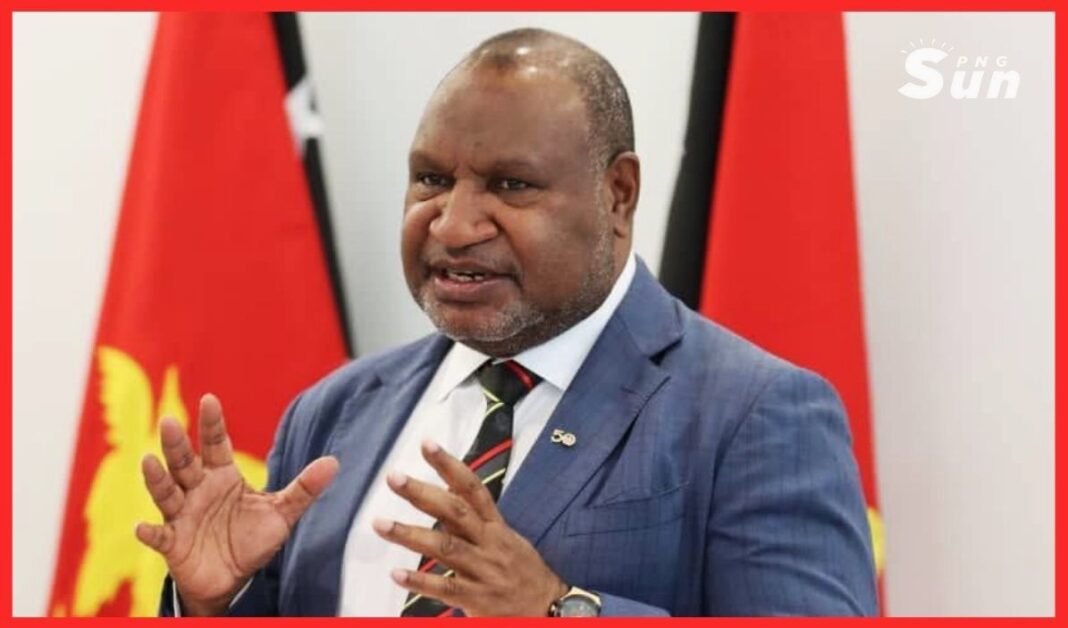

Prime Minister, James Marape has issued a clear call for a performance step-up across PNG Power Ltd and relevant government agencies, following a detailed presentation yesterday by PNG Power Chief Executive Officer Mr. Paul Bayly.
Speaking after the briefing, the Prime Minister said the presentation confirmed that Papua New Guinea’s power challenge is no longer about generation capacity, but about leadership, coordination, execution and accountability.
“We are not facing a power shortage problem — we are facing a performance problem,” Prime Minister Marape said in a media statement.
“The capacity is there. The systems exist. What is required now is a step-up in execution, coordination and results.”
The Prime Minister noted that PNG Power currently has generation capacity of around 284 megawatts in Port Moresby alone, while peak demand remains about 154 megawatts, leaving a significant volume of paid-for power unused.
“That gap is not a technical issue alone. It reflects delays, inefficiencies, weak coordination and lost opportunities. This must change,” he said.
Prime Minister Marape said government expectations were now firmly focused on delivery, not presentations or long-term excuses.
“For too long, critical transmission projects have remained unfinished for six or seven years. These delays translate directly into financial losses. This is not acceptable in a country that is paying power producers every day,” he said.
He directed the Chief Secretary to convene an urgent whole-of-government coordination meeting to clear outstanding bottlenecks, fast-track payments to contractors, and enforce timelines for completion of key transmission infrastructure linking gas-fired and renewable power into Port Moresby.
“This is about getting things done — not studying them endlessly,” the Prime Minister said.
Prime Minister Marape said PNG Power must now transition decisively from a survival mindset to a commercial performance mindset.
“You already have generation capacity. The priority now is to connect customers, sell power, collect revenue and reduce losses,” he said.
“Selling only 154 megawatts when more than 280 megawatts are available is a clear signal that performance must improve.”
He called for urgent modelling to quantify the revenue being lost from unused generation and instructed management to identify immediate opportunities to convert surplus capacity into income.
The Prime Minister stressed that government policy must actively support PNG Power by creating large, reliable electricity users.
“This is where whole-of-government performance matters,” he said. “Power utilities cannot succeed in isolation. We must deliberately attract industries that consume 10, 20 or 50 megawatts — manufacturing, downstream forestry and fisheries processing, and data-driven industries.”
He noted that Port Moresby already has the power and port infrastructure to support such industries and said clustering major industrial users in designated zones would improve reliability and efficiency.
“If reliability is the concern, then we focus resources and performance on priority industrial zones and deliver world-class reliability there,” he said.
Prime Minister Marape also called for a detailed breakdown of PNG Power’s estimated annual losses of more than K200 million, including power theft, non-payment, technical losses and internal weaknesses.
“We cannot manage what we do not measure,” he said. “I want clear data on where losses occur and who is responsible. Performance accountability must apply at every level.”
He said improving collections, eliminating illegal connections and ensuring major consumers pay their bills were essential components of restoring PNG Power’s financial health.
While acknowledging workforce pressures, the Prime Minister urged management to approach reforms responsibly.
“As leaders, our job is to fix systems first. Retrenchment must be managed carefully, with redeployment considered wherever possible,” he said.
He welcomed signs of financial improvement at PNG Power in 2025, describing them as early indicators that stronger performance is achievable.
“There are green shoots. But we must now move from marginal improvement to sustained performance,” he said.
Prime Minister Marape directed PNG Power to return with revenue modelling on selling the current surplus generation; a list of major industrial customers not connected to the grid; clear timelines for completing stalled transmission infrastructure; and practical recommendations requiring government intervention.
“My role, together with the responsible Minister, is to remove policy barriers and unlock demand,” the Prime Minister said. “But operational performance must step up. The country expects results.”
He thanked PNG Power’s management and staff for their efforts under difficult conditions and reaffirmed that government support going forward would be strongly tied to measurable delivery, efficiency and accountability.