

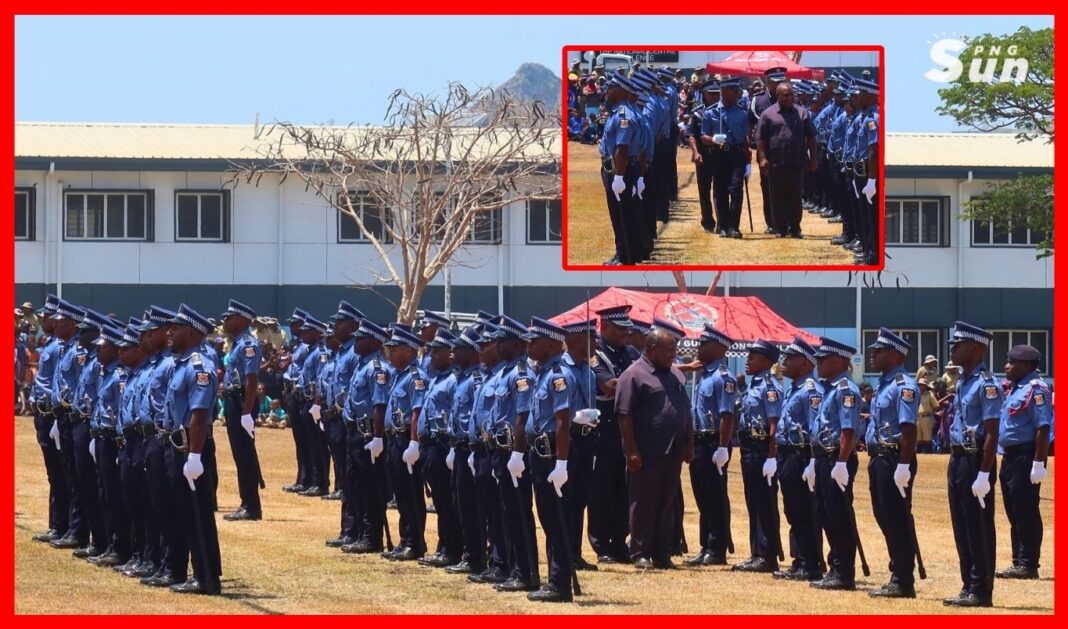

Prime Minister James Marape has challenged 54 newly commissioned police officers to serve Papua New Guinea with discipline, integrity, commitment and love for their country, warning them that their responsibility extends far beyond employment and income.
Prime Minister Marape issued the challenge last Friday at the Royal Papua New Guinea Constabulary (RPNGC) National Centre of Excellence at Bomana during the Commissioning Parade of Cadet Intake 1 of 2023.
Related news: https://www.postcourier.com.pg/loyalty-to-the-flag-not-to-politics-says-pm-marape/
The 54 officers have completed three years of cadet training designed to prepare them for leadership and command responsibilities within the Constabulary.
Prime Minister Marape said he was moved by what he saw as the officers stood on parade.
“In your eyes, I saw commitment, zeal, fire, emotion and love for your country,” he said.
“You touched my heart.”
He reminded the officers that they were taking on responsibilities extending far beyond the parade ground at Bomana and could be called upon to serve anywhere in Papua New Guinea.
Prime Minister Marape told the officers that policing must never be regarded simply as employment or a means of earning an income.
“Beyond money, it is you who will hold the country for the next 20, 30, 40 years — in fact, the next 50 years,” he said.
He reminded them that as they progressed through their careers, they would take lawful orders from their superiors, give orders to those under their command and work alongside police personnel on the frontline.
“Congratulations of the highest order to you 54. I am proud of you,” Prime Minister Marape said.
He urged them never to betray the trust placed in them by their families, the Constabulary and the country.
“Don’t let your work down. Don’t let your country down. Don’t let your family down. Don’t let yourself down,” he said.
Prime Minister Marape linked his challenge to his 51st Independence Anniversary message, “Nogat Lesman — Every Papua New Guinean Must Work.”
He said police officers, as servants of the State, had a particular responsibility to live by that principle.
“Rain or sun, you have a duty,” he said.
“Constantly work and make our country a better place for all of us.”
Prime Minister Marape urged the officers to remain disciplined and professional and to respect the command structure of the RPNGC under Police Commissioner David Manning.
He said the Government remained committed to strengthening the RPNGC through recruitment, training, infrastructure, equipment and professional development as it works towards building police manpower to 10,000 personnel.
The Prime Minister acknowledged Commissioner Manning, senior officers and instructors at the National Centre of Excellence for their work in developing the new officers.
He also thanked Australia for its continuing partnership in strengthening police training and capacity in Papua New Guinea.
“Thank you, Australia. Thank you, Australian Government, for staying with us,” Prime Minister Marape said.
He concluded by reminding the 54 officers that their commissioning was the beginning of a long responsibility to the nation.
“God bless every one of you and your country, wherever you serve,” he said.
The 54 newly commissioned officers bring an impressive range of academic qualifications, technical skills and professional experience into the RPNGC.
Their backgrounds include law and prosecution, computer science, information systems, accounting, mathematics, engineering, applied chemistry, environmental science and GIS, political science, education, nursing, aviation, automotive technology, fisheries and marine resource management, sustainable agriculture, project management and human resource management.
Before entering cadet training, members of the intake had worked as teachers, engineers, scientists, accountants, ICT professionals, nurses, mechanics, aviation professionals, managers and administrators.
Others were already serving RPNGC members with practical experience in frontline policing, prosecution, Mobile Squad operations, training and administration.
This diversity is particularly important as policing becomes increasingly complex.
Alongside traditional frontline policing, the RPNGC must build capabilities to address cybercrime, digital evidence, financial crime, fraud, money laundering, organized and transnational crime, intelligence and increasingly sophisticated criminal networks.
Officers with computer science and information systems qualifications could contribute to cybercrime and digital forensics, while those with accounting and financial backgrounds could contribute to fraud, corruption, proceeds-of-crime and money-laundering investigations.
Legal and prosecution expertise can strengthen investigations and prosecutions, while engineering, scientific, GIS, aviation, nursing and technical qualifications provide capabilities that can be applied elsewhere across the Constabulary.
Their academic and professional qualifications must be complemented by the fundamental values of policing — integrity, discipline, courage, professionalism, respect for the law and service to the community.
Related news: https://www.thepngsun.com/pm-marape-told-recruits-be-loyal-not-to-tribe-personal-affiliations-but-your-flag-your-constitution-your-uniform-and-your-country/
The challenge for the RPNGC will be to continue developing these officers and ensure their specialist knowledge and professional experience are put to effective use throughout their careers.
The commissioning of the 54 officers is therefore more than an increase in police numbers.
It brings into the Constabulary a new generation of educated and professionally experienced officers with the potential to help build a modern, disciplined and technologically capable police force for Papua New Guinea.