

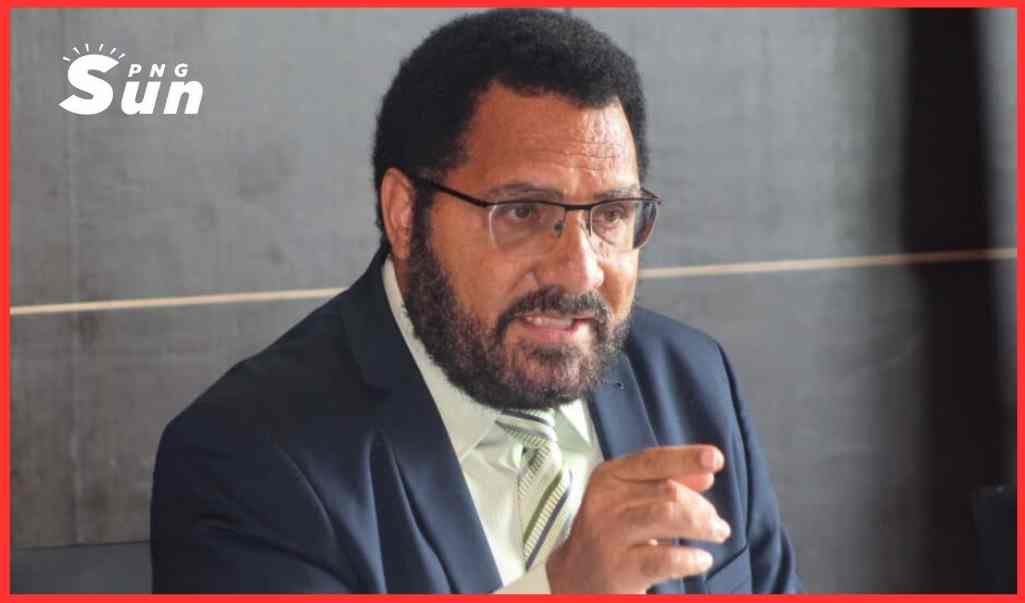

Police Minister, Sir John Pundari announced today that a comprehensive police welfare audit will become a central focus of a new police inspectorate.
He said the announcement formed part of broader reforms aimed at improving standards, accountability, and performance within the Royal Papua New Guinea Constabulary (RPNGC).
Sir John was also flagging legislative reforms including the Firearms Act to specifically change the current penalty for illegal gun holders from life sentence to death penalty.
Speaking at his first press conference held at the Stanley Hotel in Port Moresby, Sir Pundari said the welfare of policemen and women across the country must be audited to ensure that government and partner investments in housing and other support systems are properly maintained and reflected in professional conduct.
The press conference was attended by Police Commissioner David Manning and senior officers of the RPNGC. It was witnessed by supporters and local media representatives.
Hon. Pundari said welfare audits would particularly examine police housing, stressing that officers have a duty to maintain state-provided houses to a standard that reflects the integrity and discipline of the force.
“When we house you, that housing must reflect the standards you bring as an officer of the state,” he said, recalling past inspection practices where police housing conditions were strictly monitored as part of enforcing discipline and professionalism.
He added that welfare audits would run alongside two other major audit functions—police performance audits and financial audits—under the proposed inspectorate.
According to the minister, the inspectorate will conduct unannounced performance audits nationwide to assess whether officers and commanders are meeting required standards. These audits will be supported by financial audits to track funds disbursed from police headquarters to provincial police commands, as well as monies provided by provincial governments for policing operations.
Hon. Pundari said accountability was non-negotiable, warning that police commanders who misuse or abuse public funds would face arrest and prosecution.
“If that money is abused, misused, or misapplied, the PPC must be charged, arrested, and locked up,” he said, emphasizing transparency in partnerships between the police and provincial authorities.
He noted that in some cases, funds received at the provincial level were not visible to police headquarters, sometimes leaving the Commissioner unaware of large financial contributions made to provincial police commands.
The minister said the inspectorate would also assess police performance through measurable tools such as Key Performance Indicators (KPIs), duty statements, and duty rosters. He questioned whether provincial police commanders, station commanders, and divisional heads were operating under clear KPIs and whether those KPIs were being delivered.
Hon. Pundari also criticized the apparent absence of regular police parades, describing them as a basic but critical aspect of maintaining discipline, presentation, and operational readiness.
“In parades, you know if a policeman is dressed well and ready for work. In parades, you tell him exactly what he has to do in his eight hours of service,” he said, adding that neglecting such basics undermines police standards and performance.
He said the inspectorate would audit from the top levels of command down to officers across the country, including deputy commissioners, and would have the authority to travel nationwide to monitor, assess, audit, and report on policing standards.
Hon. Pundari confirmed that he has directed the Police Commissioner to strengthen and properly resource the inspectorate division with qualified national and expatriate personnel, stressing that implementation should begin immediately.
“We are not creating an inspectorate for the sake of it,” he said. “This is about improving standards, improving performance, and restoring public confidence in policing.”
He concluded by saying that with proper audits, clear KPIs, and a return to basics, improvements in law and order would naturally follow for the benefit of all citizens of Papua New Guinea.