

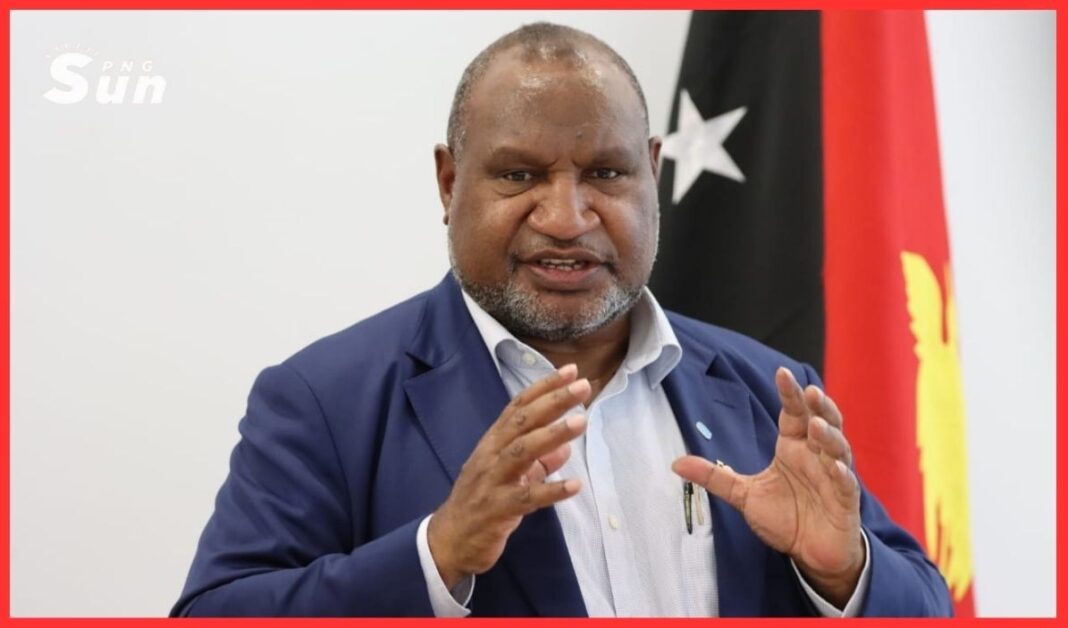

Prime Minister James Marape has addressed public concerns regarding recent movements in the Papua New Guinea kina against the United States dollar, saying the Government’s approach reflects a deliberate, long-term economic strategy aimed at strengthening domestic production, boosting exports, and ensuring sustainable foreign-exchange inflows.
Prime Minister Marape in a statement said many of the same voices now criticizing the kina’s movement were among those who previously raised concerns about the severe foreign-exchange backlog that constrained businesses and trade prior to 2019.
“When we took office in 2019, Papua New Guinea was facing a foreign-exchange backlog stretching back two to three years,” the Prime Minister said. “Businesses could not access forex to trade, import machinery, or meet legitimate obligations. That backlog has now been cleared.”
He explained that the backlog stemmed from the artificial pegging of the kina in 2015, which distorted market signals and restricted the availability of foreign exchange.
“This Government could have taken the easy route and artificially propped up the kina again,” Prime Minister Marape said. “That would have been a short-term political fix designed to make people feel good, but it would only recreate the same problems we experienced in the past.”
The Prime Minister reminded the public that in 1994 Papua New Guinea allowed the kina to float in line with market forces to ensure it was valued correctly.
“The purpose of a market-determined kina is to ensure our exports earn stronger returns when converted back into local currency,” he said. “A lower kina improves export competitiveness and helps rebalance imports and exports.”
Prime Minister Marape stressed that the policy was not imposed by external institutions.
“This is not an IMF policy,” he said. “This is a Marape–Rosso Government policy, adopted deliberately since 2019 to encourage domestic production and export-led growth.”
He pointed to global examples where countries maintain lower currency parity against the US dollar to support exports.
“Major economies such as Japan and China operate with currencies that are lower against the US dollar, so their producers earn more from exports,” he said. “That is how they stimulate production and bring foreign earnings home.”
Prime Minister Marape said Papua New Guinea’s export base is already responding, noting that more than 1.5 million bags of coffee were exported last year, alongside continued earnings from cocoa, copra, oil and gas, and the mining sector, including copper, silver and gold.
“These exports have long been the backbone of our foreign-exchange earnings,” he said.
He said the Government is also working deliberately to bring major resource projects to fruition, including Papua LNG, the Pasca oil project, and the Wafi-Golpu gold and copper project, as well as other mining and petroleum developments.
“At present, we have more than 20 projects of varying sizes in the mining and petroleum space lined up to be progressed over the next 10, 15 and even 20 years,” Prime Minister Marape said.
He emphasized that these large-scale foreign direct investments must operate within a fair and market-driven kina environment.
“When foreign investors bring US dollars into our economy, those funds must enter at the correct market value,” he said. “When converted properly into kina, the economy benefits through stronger returns and broader circulation of wealth.”
Prime Minister Marape said the Government’s approach to the kina and foreign exchange is fully aligned with the Marape Government’s Medium-Term Fiscal Strategy and its broader fiscal consolidation pathway.
He said the Government is deliberately consolidating public finances as part of a disciplined fiscal consolidation strategy aimed at restoring long-term macro-economic stability.
“This approach will, for the first time, see Papua New Guinea moving towards a balanced national budget next year, meaning no new borrowing,” the Prime Minister said.
Prime Minister Marape said the Government is continuing to unwind the artificial macro-economic settings inherited from previous administrations, noting that these distortions masked underlying weaknesses in the economy.
“We are restructuring an economy that was built on artificial numbers,” he said. “That restructuring will involve some short-term pressure in certain areas, but it is necessary.”
He said these reforms are essential to allow the economy to return to a natural equilibrium, where prices, exchange rates and investment decisions are guided by genuine market forces rather than artificial controls.
“In the medium to long term, this allows the economy to grow freely and sustainably,” Prime Minister Marape said.
He acknowledged that some sectors may feel stress during this transition, particularly those exposed to import costs, but said the Government is carefully examining targeted measures to cushion the impact.
“We are looking at ways to incentivize and support importers, including the possible reduction or removal of selected import duties,” he said. “The objective is to ensure that higher costs are not unfairly passed on to consumers.”
Prime Minister Marape said he has asked the Bank of Papua New Guinea to work towards identifying an optimal kina value against major currencies.
“This will ensure we also assist our importers through a fair and correctly valued kina against a basket of currencies that Papua New Guinea trades with,” he said.
He added that the Treasury and the Central Bank have been directed to work closely together to ensure importers are supported in a fair and responsible manner during the transition.
The Prime Minister said the policy also acts as a safeguard against capital flight.
“As a sovereign government, we do not want our kina unnecessarily spent overseas,” he said. “We want kina circulating within our economy, while attracting US dollars and other foreign currencies into Papua New Guinea through exports and foreign direct investment.”
He also called on exporters to fully remit their foreign-currency earnings through the country’s financial system.
“I encourage all exporters to remit more of their foreign exchange through our central banking system, within a regulatory environment that is receptive and supportive, so that more foreign currency is brought back into Papua New Guinea to support business growth and economic stability,” Prime Minister Marape said.
He acknowledged that a weaker kina also affects those paying overseas school fees or purchasing goods abroad and assured them that the Government is also looking at ways to help, as it is doing in other sectors of the economy.
“For everyday households, this Government continues to provide relief,” Prime Minister Marape said. “We have removed GST from essential household items, lifted the tax-free threshold to K20,000, continued paying school fees, and provided targeted support to ease cost-of-living pressures.”
He said the Government continues to closely monitor prices of essential goods and will intervene where necessary to protect ordinary Papua New Guineans, as well as local businesses reliant on imported inputs.
“Our objective is clear,” the Prime Minister said. “We want to stop the export of kina and instead import foreign currency into our economy — whether through stronger export earnings or increased foreign direct investment, where dollar inflows convert into higher kina returns locally.”
Prime Minister Marape said the Government is also advancing reforms to reduce reliance on the US dollar in international trade.
“We are making strong progress on direct kina–renminbi convertibility,” he said. “This will allow trade with China to be conducted directly between our currencies, rather than through the US dollar, reducing costs and exposure.”
He reassured the public that the foreign-exchange market is monitored daily.
“We understand the dynamics of the forex market, and we are managing this economy deliberately and responsibly,” Prime Minister Marape said. “This policy approach is designed to stimulate growth, protect economic sovereignty, and build a stronger, more productive Papua New Guinea.”