
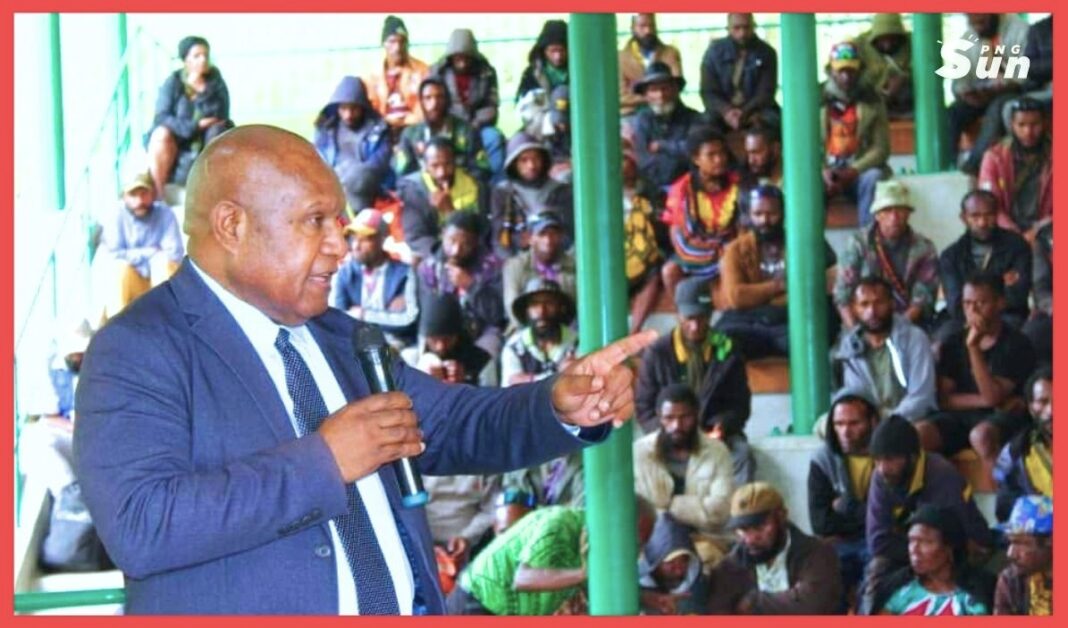

A new ward-level development approach will be rolled out across Papua New Guinea and is set to shift the country’s planning system from a top-down model to one driven by communities, with a strong focus on job creation, local production and rebuilding social structures.
Secretary for the Department of Provincial and Local Level Government Affairs, Mr. Philip Leo, said the National Framework for Ward Development is designed to place villages at the center of economic growth, supported by a digital National Ward Record System that will guide planning and decision-making.
Related news: https://png.iom.int/news/hiwa-tumbiali-launches-comprehensive-ward-development-plan
“For the last 50 years, we have been planning from the top down,” Mr. Leo said at the Provincial Administrators Conference at the Hilton hotel in Port Moresby when launching the two Policies this morning.
“As a result, our people have been disengaged and trust has been lost.”
“Under the framework, development will be planned and implemented at the ward level, with communities identifying priorities and making decisions on how funds are spent”, he said.
Each of the country’s 6,912 wards will receive K30,000, which Mr. Leo stressed will be tightly controlled and directed into five key areas:
• Early childhood education
• Community peace and order
• Community health and hygiene
• Solar energy and lighting
• Small and medium industries
“That money is not lost,” Leo said. “We are now going to plan development and control development in this country.”
Ward governance structures will include councilors providing political leadership, ward committees managing records and finances, and the broader community making final decisions.
“The decision is made by the people,” Mr. Leo said.
“The role of those in the middle is only to manage and record.”
Supporting the framework is the National Ward Record System, which digitizes the old village record books into a modern data platform.
“In the 60s, our parents lined up to be recorded in village books. Today, that system is digital,” Secretary Leo said.
Ward recorders will collect demographic and socioeconomic data as part of their daily responsibilities, creating what Secretary Leo described as “the backbone infrastructure for this country.”
“If we get it right, we can clear 30 to 40 percent of the backlog of issues we carry,” he said.
He said a central goal of the framework is large-scale employment through coordinated ward-level production, particularly in agriculture and small industries.
Secretary Leo used peanut farming as an example of how quickly jobs could be created.
“If we mobilize 100 women in each ward, that’s 700,000 people in one industry,” he said.
“Add another product line, and you are talking about millions of people engaged.”
He said such an approach makes the government’s target of one million jobs achievable.
“The capital is there, the land is there, the people are there,” he said.
“Development will not happen in the air-it will happen in the villages.”
The framework also promotes downstream processing and imports substitution, encouraging communities to produce goods currently brought in from overseas.
Products such as peanut oil, peanut paste and livestock feed from cocoa by-products have been identified as practical starting points.
“We should not be exporting raw products and importing finished goods,” Mr. Leo said.
“We must start replacing what we import.”
Mr. Leo said the initiative also aims to restore traditional communal systems that have weakened over time.
“In the past, communities worked together. Today, everything is paid for,” he said.
“We must rebuild that social capital.”
The framework includes a role for skilled individuals in villages-including retirees-to contribute their expertise to local projects without cost.
Mr. Leo said funding for ward development will be drawn from multiple sources, including the K30,000 ward allocation, Public Investment Program funds, District and Provincial Service Improvement Programs, and support from development partners and the private sector.
“That is where the money must go-to where our people are,” Mr. Leo said.
He said the framework itself is already complete, and the priority now is execution at the local level.
“We cannot keep telling our people to plan,” he said. “The planning is already done. What we need now is implementation.”
He urged all provincial administrators to support the rollout and ensure communities are mobilized to take ownership of development activities.
Related news: https://www.thepngsun.com/ward-councillor-pay-critical-enabler-for-development-leo/
“If we change our villages, we will change this country,” Mr. Leo said.