

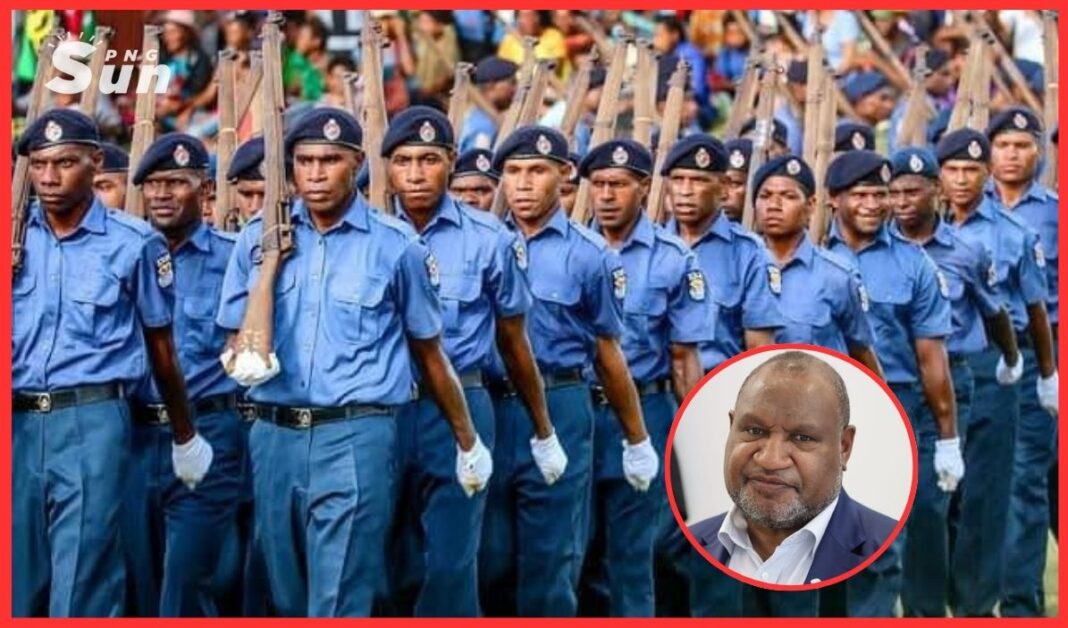

Prime Minister, James Marape has commended the country’s Police Force for successfully freezing K214 million held in a trust account.
In a statement today, PM Marape described the action as a major step forward in the Government’s ongoing fight against corruption and money laundering.
The Prime Minister confirmed that police obtained a court stay order under the Proceeds of Crime Act (POCA) to prevent the transfer of the funds, which are believed to rightfully belong to the people of Western Province, following intelligence that the money was about to be moved into subsidiary accounts.
“I want to commend the police for acting swiftly and decisively. From the reports I have received, this K214 million belongs to the people of Western Province, and police have successfully stopped it from being transferred or dissipated,” Prime Minister Marape said.
He said the onus is now on those holding the account to explain the source and purpose of the funds.
“Police have informed me that those involved have six months to account for the money — where it came from, why it is being held, and for what purpose. If the court is not satisfied, the funds will be recovered and returned to their rightful beneficiaries,” he said.
The restraint order was secured under the Proceeds of Crime Act, Papua New Guinea’s principal legislation for freezing, seizing and forfeiting assets suspected to be derived from criminal activity, including corruption and money laundering. The POCA framework allows law enforcement agencies to act swiftly to preserve suspected proceeds while investigations and court processes are ongoing, preventing funds from being concealed, transferred offshore, or dissipated.
Police investigations indicate that the restrained funds were held in a professional trust account and were at risk of imminent movement into subsidiary accounts, triggering urgent action to preserve the money pending further examination. Under POCA provisions, the restraint does not determine guilt but ensures that funds remain secured while authorities establish whether the money constitutes proceeds of crime and whether forfeiture proceedings should follow.
If the court ultimately determines that the funds are state monies or proceeds of unlawful activity, the legislation provides for recovery and forfeiture to the State, with potential prosecution of individuals involved — including professionals entrusted with managing such accounts — where breaches of the law are established.
Prime Minister Marape emphasized that the fight against corruption is not a one-off event, but a sustained process that requires long-term investment in law enforcement capability.
“Fighting corruption is not a one-day activity. It is an ongoing process. Over the years, we have strengthened the police force — particularly the forensic units, the Fraud Squad, training divisions, and specialised units — to ensure they have the capacity to deal with complex financial crimes,” he said.
He acknowledged the role of the former Police Minister Hon. Peter Tsiamalili Jr and the Police Commissioner David Manning in strengthening the Fraud Squad, including the appointment of an experienced Commonwealth officer to lead investigations into major money-laundering transactions across national and provincial governments.
“That work is now bearing results. Police are actively examining multiple high-value transactions and suspicious dealings across the country,” the Prime Minister said.
Prime Minister Marape issued a strong warning to public office holders and others involved in managing public funds.
“To anyone working in public office: do not launder money, do not siphon public funds, and do not submit false claims. Records exist, and police now have the capacity to trace and recover illegally obtained state funds,” he warned.
He said the Government has strengthened oversight across key agencies, including Planning, Finance and Treasury, and is engaging major accounting firms to scrutinize investments and transactions.
“This Government is serious about stopping illicit financial flows. Only legitimate transactions meant for goods and services for our people should proceed through government systems,” he said.
Prime Minister Marape said that if investigations confirm the funds are state money, recovery will be pursued under the Proceeds of Crime Act, and those responsible — including professionals holding funds in trust — will face prosecution.
“If there is no satisfactory explanation, the money will be recovered and those involved will be dealt with according to the law,” he said.
Addressing Papua New Guinea’s possible grey-listing status, the Prime Minister reaffirmed the Government’s resolve.
“Grey list or not, our fight against corruption will continue. Police are now working closely with financial intelligence authorities and the Ombudsman Commission to pursue those who have stolen from the state,” he said.
“This successful action in freezing K214 million shows that this Pangu-led Government’s institutional strengthening of constitutional offices to fight corruption is showing results. I am encouraged that white-collar theft of public resources is no longer optional policing work, but mainstream police business.”
“I commend the Police and call on them to pursue all suspicious bank accounts in our country that benefit from corruption.”