

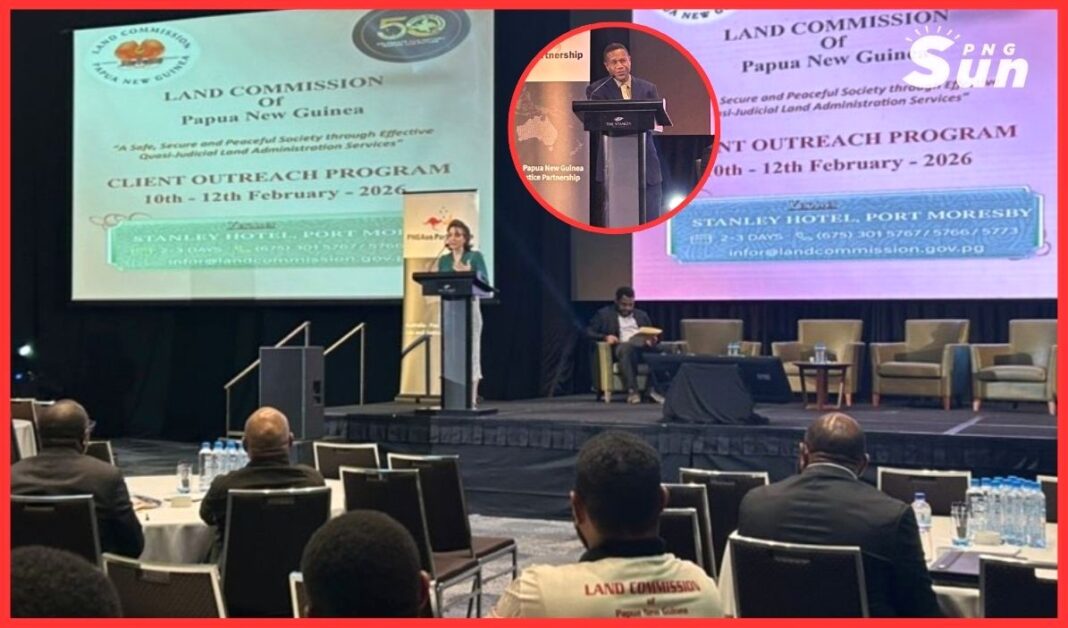

The Land Commission of Papua New Guinea has taken another important step toward strengthening transparency, service delivery and public confidence with the completion of its 2026 Client Outreach Program in Port Moresby.
The three‑day event last week brought together government partners, industry, community representatives, and legal experts to discuss land governance, major reforms under the Land Commission Act 2022, and the Commission’s expanding role as PNG’s independent, quasi‑judicial body responsible for resolving complex land matters.
Supported by the Australia–PNG Law and Justice Partnership, the program forms part of Australia’s broader commitment to strengthening PNG’s justice institutions – including the newly established Land Commission.
In his opening remarks, Mr. Keith Iduhu, Chairman of the Special Parliamentary Committee on Customary Land, underscored the significance of the reforms underway.
“Customary land is our greatest asset. We must protect it, empower landowners, and pursue development that brings prosperity without compromising our environment,” he said.
Chief Commissioner Molean Kilepak highlighted the value of the outreach program as the Commission transitions into a modern, people‑centered institution.
“As PNG marks 50 years of independence, the Land Commission renews its commitment to unlocking the potential of customary and national land, strengthening our history, and building a safe, secure and peaceful society through effective and transparent land administration,” he said.
Established on 2 September 2025, the Land Commission brings together the former Land Titles Commission and National Lands Commission into one unified body. Under the Land Commission Act 2022 and its Corporate Plan 2023–2027, the Commission’s work includes:
1. determining customary land ownership and facilitating dispute resolution through a fair, independent, quasi‑judicial process
identifying, confirming and registering colonial land acquisitions as National Land
2. supporting land tenure conversion and clarifying rights for public infrastructure and economic development
3. improving transparency through modernized systems, including a National Land Register, digital case management, and GIS‑linked mapping
4. strengthening partnerships across government, communities and the law and justice sector.
These reforms are central to ensuring PNG has a reliable, transparent land administration system that protects customary rights and supports national development.
Australia is proud of the deep and longstanding partnership with PNG in law and justice.
Supporting the Land Commission is a natural extension of that work, helping strengthen systems that improve fairness, transparency and access to justice for all Papua New Guineans.