

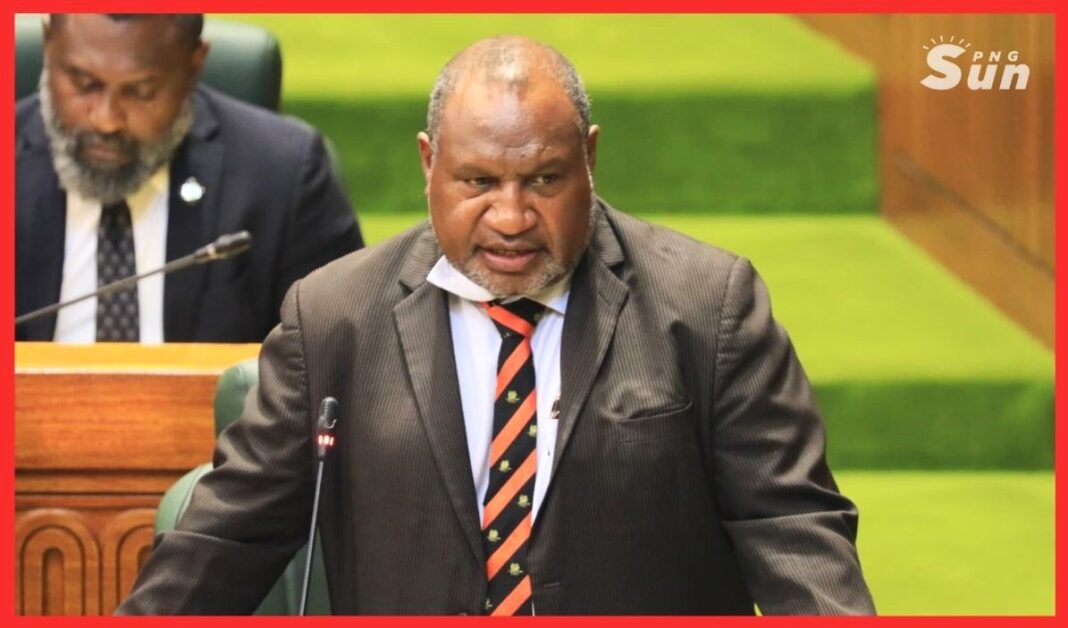

Prime Minister, James Marape says Parliament must carefully and thoughtfully consider proposals contained in the Constitutional Law Reform Commission (CLRC) Report, including the possible direct election of the Prime Minister by the people.
“This conversation is not about preserving any individual in office. It is about strengthening the system of government so that it provides stability, protects democratic accountability, and allows our public service to operate effectively for the benefit of our people,” Prime Minister Marape said.
Related news: https://www.pngbusinessnews.com/articles/2023/2/process-of-electing-prime-minister-to-be-reviewed
He emphasized that the report also raises important questions about the roles of different levels of government, including provincial governments, District Development Authorities, and local-level governments, with the aim of clarifying responsibilities and improving service delivery.
“These discussions give us an opportunity to address weaknesses in our governance structures and ensure responsibilities are clearly defined so that resources are used effectively and accountability is strengthened,” he said.
The Prime Minister has called on Members of Parliament and the people of Papua New Guinea to engage in a thoughtful national conversation on strengthening the country’s democratic system, as Parliament resumed debate on the report of the Constitutional Law Reform Commission regarding the form and system of government.
The report includes proposals on possible reforms to the current system, including the potential direct election of the Prime Minister by the people.
Speaking yesterday during the resumed parliamentary debate on the Commission’s final report—following initial discussions in October last year—Prime Minister Marape said the report comes at a significant moment in Papua New Guinea’s history as the nation moves beyond its 50th year of independence.
The Prime Minister commended the Commission, led by Chairman Hon. Saki Soloma (Okapa MP), for its extensive national consultations and comprehensive work over several years.
“I commend the Chairman and members of the Constitutional Law Reform Commission for leading a nationwide consultation process and presenting to Parliament a report that invites us to reflect on the future of our democracy,” Prime Minister Marape said.
“This report comes at a time when our nation has passed through 50 years of nationhood, and we now have the benefit of hindsight to examine what has worked well and what needs strengthening.”
Prime Minister Marape noted that Papua New Guinea’s Constitution, established at independence in 1975, has served the country well in uniting one of the most diverse nations in the world under a single democratic framework.
“Our founding fathers and mothers crafted a constitution without the benefit of 50 years of experience. Today, as we celebrate our Golden Jubilee, we have accumulated valuable lessons that can help strengthen the structure of our democracy for the next generation,” he said.
The Prime Minister emphasized that the CLRC report is not intended to replace the existing democratic system but to encourage reflection on how governance structures can be improved to deliver better outcomes for citizens.
“This report is not about reinventing the wheel. It is about asking ourselves important questions—what are the strengths of our democracy? What are the weaknesses? And how can we strengthen it so that it better serves our people and future generations?” he said.
Among the issues raised in the report are questions regarding the stability of government, the effectiveness of the current parliamentary system, and whether structural adjustments could improve governance and service delivery.
Prime Minister Marape highlighted the importance of political stability, noting that frequent changes of government during the early decades of independence affected national development.
“In the first 27 years of our nationhood, governments changed on average every 18 months to two years. Much of our national energy was spent forming governments instead of focusing on development and economic progress,” he said.
He pointed to reforms introduced in the early 2000s that strengthened political stability and helped lay the foundation for economic growth.
“When stability was achieved, it enabled governments to focus on rebuilding the fundamentals of our economy and governance systems. Stability is therefore an important factor we must consider while ensuring accountability and transparency remain strong in our democratic framework,” he said.
Prime Minister Marape also highlighted the Commission’s extensive consultations across the country, describing the process as one of the most significant national consultations since the early years of independence.
“The Commission consulted widely with citizens across the country through multiple platforms, including community engagement and online questionnaires. This reflects the importance of ensuring that any discussion on our system of government includes the voice of the people,” he said.
Prime Minister Marape encouraged Members of Parliament on both sides of the House to carefully consider the report and contribute constructively to the debate as part of shaping Papua New Guinea’s governance framework for the future.
“I invite all party leaders and Members of Parliament to study this report seriously and contribute their ideas so that together we can strengthen the foundations of our democracy and pass on a stronger system of governance to the next generation,” he said.
The Prime Minister added that while the current system will remain in place for the 2027 National General Election, the discussions provide an opportunity for long-term reform that could shape the country’s governance structure in the decades ahead.
“As we move toward future milestones, including our 60th anniversary in 2035, we must ensure that our political structures are stable, transparent, and capable of delivering effective services to our people,” Prime Minister Marape said.