

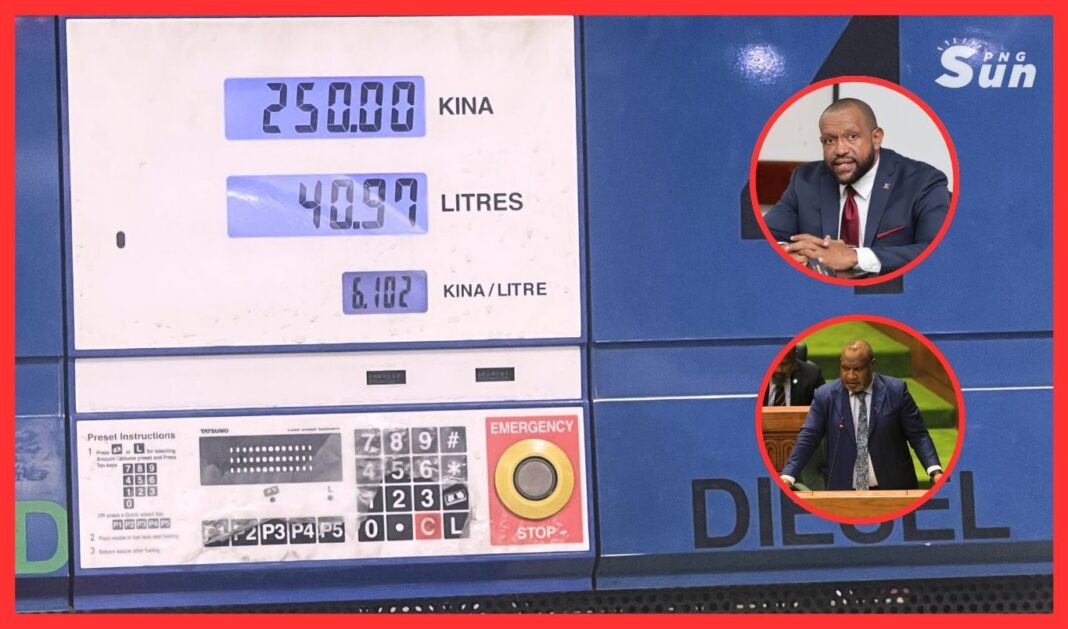

Prime Minister James Marape has hit back at Opposition Leader James Nomane, strongly defending the Government’s K1 billion Fuel Stabilization Package as a timely and lawful move to protect Papua New Guineans from rising global fuel prices and economic pressure.
Mr. Nomane said the announced package must be subjected to Parliamentary scrutiny.
PM Marape said the intervention is not a reactionary measure, but a calculated and responsible decision grounded in existing legal and fiscal frameworks, aimed at easing the burden on ordinary citizens during a worsening international energy crisis.
“This is not panic. This is responsible leadership in a time of global crisis,” he said.
“We are not waiting for hardship to hit our people before acting — we are acting early, decisively, and within the full scope of the law.”
He dismissed claims that the Government had bypassed proper processes, clarifying that there is no need to recall Parliament as the measures are being implemented through existing Government policy instruments and approved fiscal mechanisms.
“There is absolutely no breach of process. What we are doing is fully provided for within Government policy settings and National Executive Council decisions,” PM Marape said in a statement.
“We are utilizing available instruments — including GST adjustments, fuel levies, and tax credit arrangements — to deliver immediate relief.”
The Prime Minister explained that the initial K100 million allocation is sourced from provisions already captured in the 2026 National Budget and NEC-approved funding arrangements.
“We have not gone outside the law. We are using what is already legally available to Government to respond quickly in the best interest of our people,” he added.
PM Marape confirmed that the Government is working closely with the country’s major fuel importers — ExxonMobil, Puma Energy, and Ok Tedi Mining — to ensure steady supply while cushioning consumers from price spikes.
“We are supporting our importers so they can buy fuel at high international prices, but sell domestically at affordable rates,” he said. “The intention is simple — no extra burden must be passed on to our people.”
He said the package includes temporary tax and levy adjustments, tax credit arrangements, and direct fiscal support to help bridge the gap between global and domestic fuel prices.
“This is a relief package designed to protect households, transport operators, and businesses across the country.”
PM Marape also assured the public that strict oversight mechanisms remain in place, with the Bank of Papua New Guinea and the Independent Consumer and Competition Commission continuing to monitor the implementation.
“We will ensure transparency and accountability at every level. Every toea of support must benefit the people — not be lost in the system,” he said.
He stressed that any past or ongoing concerns in the fuel sector are being handled independently by relevant authorities and will not interfere with urgent measures to support citizens.
“Issues raised in the past are being handled by the appropriate authorities. This Government will not interfere with due process, but neither will we allow those issues to delay urgent relief for our citizens.”
Pointing to improving revenues from PNG LNG exports, PM Marape said the Government has the fiscal space to act without destabilizing the national budget.
“As global prices rise, our resource revenues — particularly from LNG — are also improving. This gives us the fiscal space to act responsibly,” he said.
While leaving the door open for a supplementary budget if needed, he emphasized that immediate action was critical.
“Leadership is about timing. We cannot delay relief while waiting for lengthy processes when our people need help now.”
He criticized the Opposition’s stance as political and out of touch with the realities facing everyday Papua New Guineans.
“In times like this, leadership must rise above politics. Our focus is not on scoring points — it is on protecting lives and livelihoods,” he said. “Papua New Guineans expect action, not delay.”
Reaffirming his government’s commitment, Marape said the fuel stabilization measures form part of a broader strategy to maintain economic stability during global uncertainty.
“We have done this before during COVID-19, and we will do it again. Government must step in when external shocks threaten our people,” he said. “Our duty is clear — to stand between global crisis and the everyday Papua New Guinean.”