
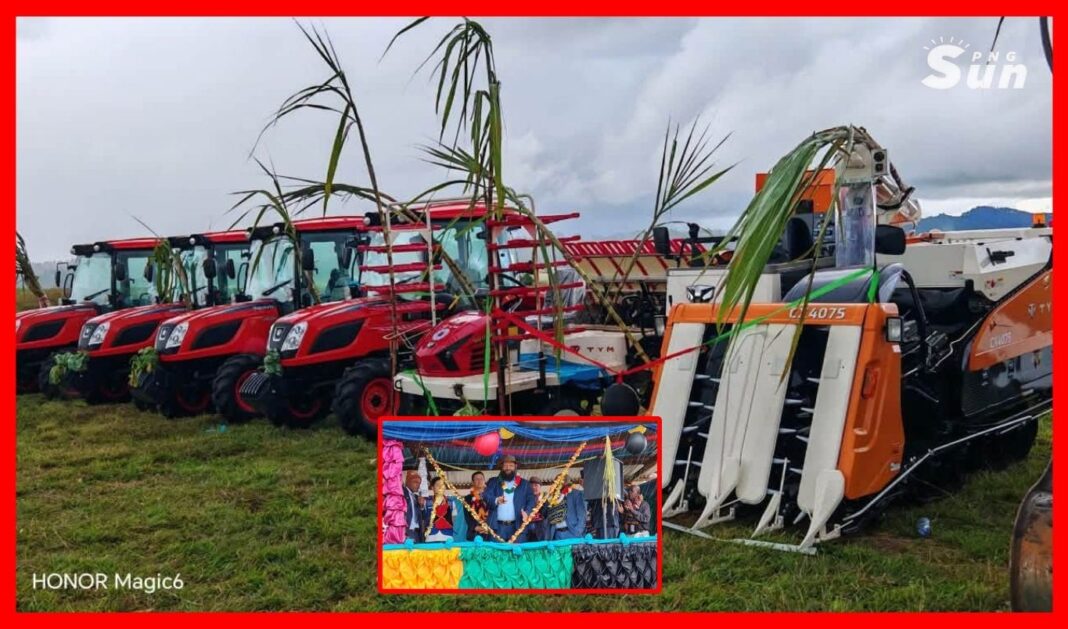

Papua New Guinea has moved closer to rice self-sufficiency after the Republic of Korea handed over eight tractors and modern farming equipment to the Norikori Rice Project to boost local production and reduce imports.
The equipment was donated through the Korea International Cooperation Agency (KOICA), with additional rice farming machinery funded by the National Government through the Department of Agriculture and Livestock.
The handover took place last Thursday and was officiated by His Excellency Choi Jong Ho, Ambassador of the Republic of Korea to Papua New Guinea, alongside Agriculture Minister Hon. John Boito, Department of Agriculture and Livestock Secretary Dr Sergie Bang, and National Rice and Grain Board Chairman and Chief Executive Officer Mr. Koren Rokas Maso.
Also present were Ms. Jeong-Eun Song, KOICA Country Director, a visiting KOICA regional representative, Eastern Highlands Provincial Administrator Mr. Allan Los, Deputy Provincial Administrator Mr. John Gare, National Agricultural Research Institute Director-General Dr Nelson Simbiken, local-level government presidents, ward councillors, customary landowners, community leaders and invited guests.
The ceremony highlighted the long-standing partnership between Papua New Guinea and the Republic of Korea in strengthening food security, increasing agricultural productivity, creating jobs and supporting sustainable rural development.
Speaking at the event, Minister Boito thanked the Government and people of the Republic of Korea and KOICA for their continued support for Papua New Guinea’s agriculture sector.
He said agriculture remains a key priority of the Marape-Rosso Government as it works to transform the economy by increasing domestic food production and strengthening opportunities for local farmers.
“Every bag of rice we produce here in Papua New Guinea represents income for our farmers, employment for our people and money that stays within our economy instead of flowing overseas through imports,” Minister Boito said.
He said the Government remained committed to accelerating rice development and commercialization and had appointed Mr. Maso through a National Executive Council decision to lead expansion of the national rice programme.
Future commercial rice operations are expected to expand into areas including Unggai-Bena in Eastern Highlands Province, Baiyer in Western Highlands Province, Vanapa and Launakala in Central Province, and the Central Sepik Plains.
Minister Boito said the Norikori Rice Project would serve as a national demonstration center for mechanized farming, farmer training, technology transfer and commercial rice production that could be replicated across the country.
The newly delivered machinery is expected to improve land preparation, planting, harvesting and post-harvest processing while increasing production capacity and providing practical training opportunities for farmers nationwide.
For local communities, the event carried added significance.
After three months of drought, heavy rain fell over Norikori as the ceremony concluded, bringing relief to farmers and preparing the newly ploughed land for rice seedling transplantation scheduled for next week.
Many local residents described the rainfall as a timely blessing and a sign of hope for the future.
As the ceremony ended, Ambassador Choi rallied the gathering with the words: “Together we can.”
The message reflected the broader vision behind the project — combining investment, technology and partnership to support Papua New Guinea’s long-term goal of producing more of its own food.
With fertile land, abundant water resources, government commitment and support from development partners including the Republic of Korea and KOICA, the Norikori Rice Project is emerging as a practical model for advancing rice self-sufficiency.
If replicated across Papua New Guinea, projects such as Norikori could strengthen rural livelihoods, improve national food security and retain millions of kina within the domestic economy.