

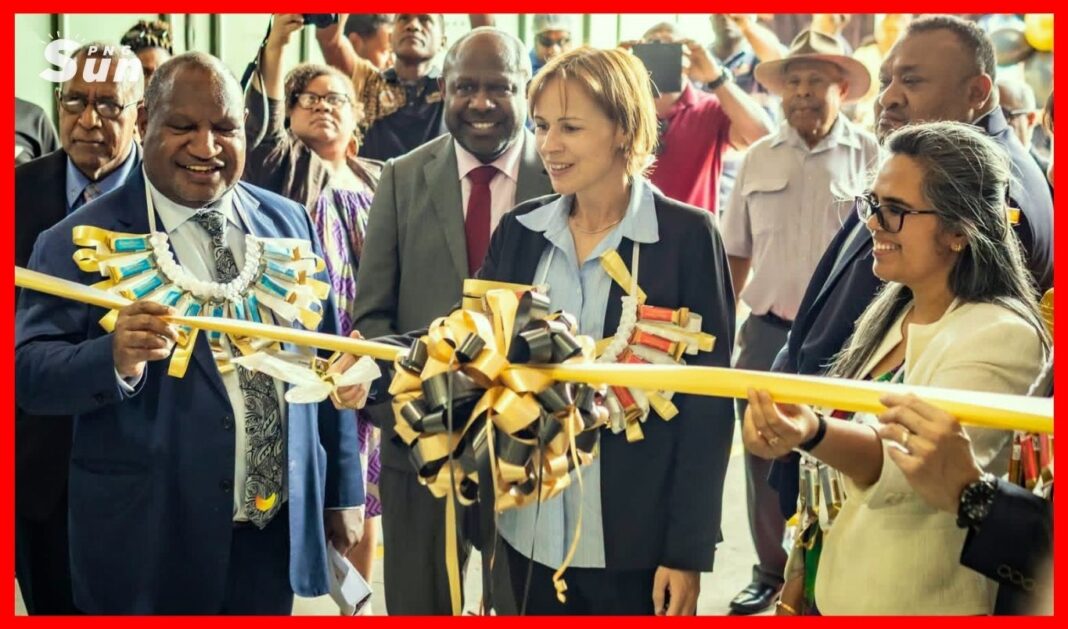

Prime Minister James Marape has commended the expansion of the Queen Emma Chocolate Factory as a major step towards keeping more value from Papua New Guinea’s cocoa industry within the country.
Mr. Marape officially opened the upgraded factory in Port Moresby this week.
He described the investment by 100 per cent Papua New Guinean-owned Paradise Company Limited as a practical example of the Government’s downstream-processing policy.
The K18.6 million upgrade has increased the factory’s chocolate processing capacity 20-fold, from 10 tonnes to 200 tonnes a month.
“I am privileged to witness a historic new chapter in the downstream processing of Papua New Guinea cocoa into finished products by Paradise Foods,” Mr. Marape said.
“I commend this 100 per cent Papua New Guinean-owned company for converting our Government’s policy intentions into reality.”
The project comprises K11.5 million provided by the European Union through the EU-STREIT PNG Programme with the Food and Agriculture Organization, matched by K7.1 million from Paradise.
Mr. Marape said the investment demonstrated how PNG could move away from exporting raw commodities and towards producing, processing, manufacturing and exporting higher-value products.
“For too long, we have grown cocoa in our villages, exported the raw beans and allowed much of the value to be added overseas,” he said.
“Paradise Foods is showing us that we can grow it here, process it here, manufacture it here, package it here and sell the finished product to the world.”
Mr. Marape said PNG produces some of the world’s finest cocoa but must capture a greater share of the global cocoa and chocolate industry.
He said the global chocolate market was worth more than US$100 billion annually, presenting a significant opportunity for PNG producers and processors.
Paradise Foods is owned by Papua New Guinean interests, with Nambawan Super and Comrade Trustees acquiring the company from Arnott’s in 2007.
More than 99 per cent of its workforce of over 1,200 people are Papua New Guineans.
“This is Papua New Guinean capital at work — employing Papua New Guineans, buying from Papua New Guinean farmers and manufacturing Papua New Guinean products,” Mr. Marape said.
Paradise, with support from Nambawan Super, has invested more than K200 million over the past 12 years to expand its ice cream, snacks, biscuits and culinary production.
Mr. Marape said the Government would work with Paradise Foods to ensure freight support, commodity price support and agriculture policies helped cocoa farmers supply the expanded factory.
He said the factory was expected to require more than 2,000 tonnes of cocoa beans annually as production expanded.
That demand could generate more than K43 million directly and reliably for more than 10,000 smallholder farming families across four provinces.
“The factory cannot operate without cocoa, and the cocoa cannot come without our farmers,” Mr. Marape said.
“Our policies must therefore connect the farmer in the village right through to the factory and ultimately to the international consumer.”
Mr. Marape said reliable markets and fair returns would encourage farmers to remain on their land and continue producing cocoa.
He also proposed that the Government work with Nambawan Super to develop a model that would allow farmers to contribute part of their agricultural earnings towards long-term superannuation savings, with the possibility of Government matching contributions.
“A hardworking cocoa farmer should have the opportunity to build retirement savings just like a teacher, nurse, police officer or other salaried worker,” he said.
Mr. Marape said local processing could substantially increase the value retained in PNG.
He said raw cocoa exported at about K25 per kilogram could be transformed locally into cocoa butter, cocoa mass, cocoa liquor and chocolate products worth about K55 to K60 per kilogram.
“This is what economic independence looks like in practical terms,” he said.
“We must stop being satisfied with exporting raw materials and buying back finished products at much higher prices.”
Mr. Marape also welcomed Paradise’s longer-term plan to establish a large-scale chocolate processing facility in Lae capable of producing up to 1,000 tonnes of processed cocoa and chocolate a month.
The proposed facility has the potential to generate up to K500 million in export revenue for PNG.
“I want Queen Emma chocolate and other quality PNG-made products to reach supermarkets and consumers throughout Australia, Asia, Europe, North America and other international markets,” Mr. Marape said.
“Every Queen Emma chocolate sold overseas represents PNG cocoa, a PNG farmer, PNG employment and PNG income.”
Mr. Marape congratulated Paradise Foods, its shareholders, management and workers, cocoa farmers, the European Union, FAO and other development partners involved in the factory expansion.
“This is the direction Papua New Guinea must take: grow it in PNG, process it in PNG, make it in PNG and sell it to the world,” he said.