

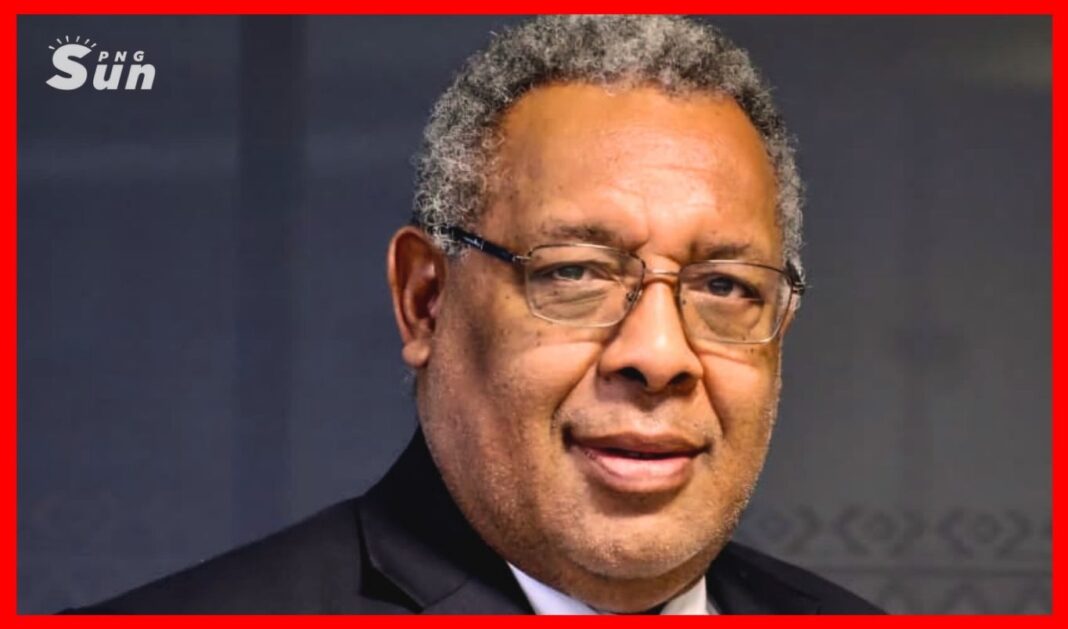

Chief Secretary to Government Ambassador Ivan Pomaleu has clarified that the country’s laws do not require the Electoral Commissioner to be a citizen, amid public speculation over the possible appointment of a non-citizen to the constitutional office.
Mr. Pomaleu said the Government remained fully committed to upholding the Constitution and the country’s laws in all appointments to constitutional offices.
He said such appointments were not based on political preference but were guided by the legal framework established by Parliament and supported by independent legal advice.
In a statement, Mr. Pomaleu explained that the appointment process is governed by Section 126(7) of the Constitution and Part II of the Organic Law on National and Local-level Government Elections.
He said the Electoral Commissioner is appointed by the Head of State, acting on the advice of the Electoral Commission Appointments Committee, a process designed to protect the independence of the office.
Addressing claims circulating in public, Mr. Pomaleu said neither the Constitution nor the Organic Law requires the Electoral Commissioner to be a Papua New Guinea citizen.
He said while the Organic Law outlines the qualifications, term of office, disqualifications and restrictions for the position, it does not include citizenship as an eligibility requirement.
“Where Parliament has intended citizenship to be mandatory for public office, it has expressly legislated for such a requirement. No such requirement exists for this office,” Mr Pomaleu said.
He added that if a non-citizen were appointed, the appointment would be made lawfully under the Public Employment (Non-Citizens) Act.
Mr. Pomaleu said the Act requires the State to enter into a lawful employment contract consistent with the Organic Law and the determinations of the Salaries and Remuneration Commission for constitutional office holders.
He said all candidates would continue to be assessed on merit, competence, integrity, independence and their ability to carry out the constitutional responsibilities of the office.
“Papua New Guineans rightly expect elections to be conducted with impartiality, transparency and professionalism.”
“These expectations are shared by Government, and every decision relating to the Electoral Commission will continue to be guided by the Constitution, the rule of law and the long-term integrity of our democratic institutions,” he said.
Mr. Pomaleu acknowledged that public debate and scrutiny were important parts of democracy but urged people to ensure discussions were informed by the law rather than speculation.
He reaffirmed the Government’s commitment to protecting the integrity, independence and credibility of Papua New Guinea’s electoral system by ensuring all constitutional appointments are made lawfully, transparently and in the nation’s best interests.