

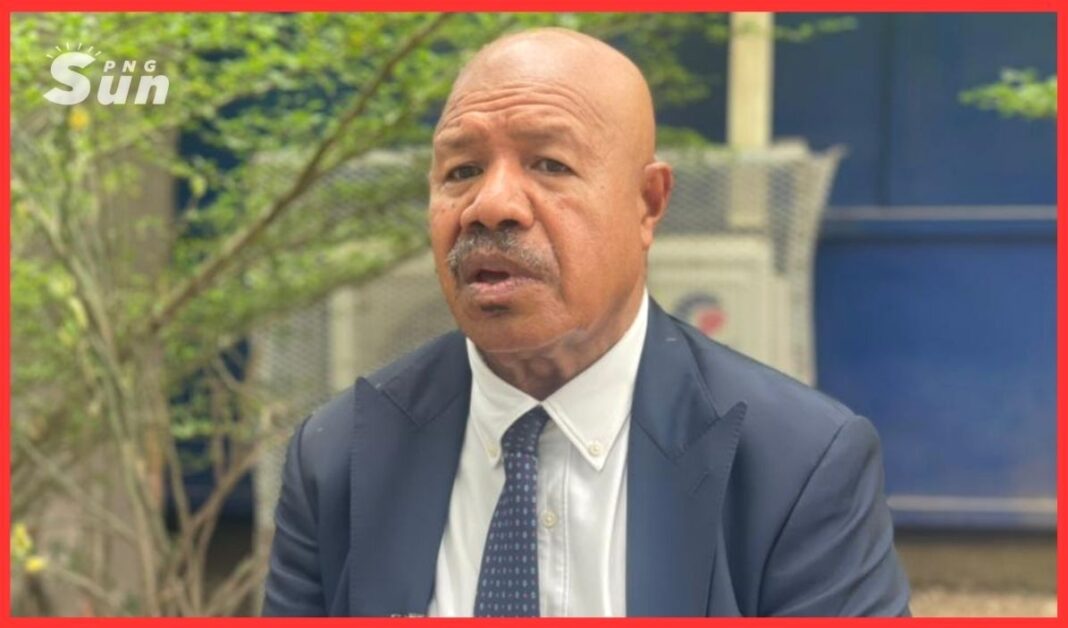

The National Capital District (NCD) Governor Powes Parkop, has weighed in on Papua New Guinea’s placement on the Financial Action Task Force (FATF) grey list, urging calm and accusing the Opposition of misrepresenting the issue for political gain.
Papua New Guinea was placed on the grey list by the Financial Action Task Force on February 13, alongside Kuwait.
Over 24 countries were also included in this list including Vietnam, Laos, Congo, Bolivia, Monaco, Angola, Cameroon, Kenya …etc.
“It’s not the first time too for PNG to be grey listed. In 2015 we got on the list and were able to get off the list quickly,” Governor Parkop recalled.
This listing has triggered national debate over the country’s financial governance and economic management.
Governor Parkop dismissed claims that the listing reflects a failure in monetary or fiscal management or management of the economy generally.
“The Opposition has been making a big hue and cry over the grey list when this has nothing to do with how our government and Treasurer are managing our monetary policies, fiscal policies or the economy generally,” he said.
Governor Parkop clarified that the grey listing is due strictly to “strategic deficiencies in combating money laundering and terrorist financing,” not broader economic mismanagement.
According to Governor Parkop, the designation signals increased monitoring by the global watchdog and points to weak enforcement, poor inter-agency coordination, and inadequate supervision of financial institutions in relation to money laundering and terror financing efforts or measures.
“The public need to know this. We cannot not allow the Opposition to take advantage and mislead the public as if the Government has committed some cardinal sin in the economy or financial system resulting in this grey listing. Yes, there are issues with the management of the economy, but these are not the causes of the grey listing he said.
Governor Parkop stressed that addressing the issue is achievable, calling for stronger coordination among government agencies.
He continued that the Central Bank and the Internal Revenue Commission must take the lead in improving compliance and supervision and putting the necessary measures to counter terrorism and money laundering.
“It just needs us to ramp up inter-agency coordination. It’s absolutely doable,” he added.
However, Governor Parkop also acknowledged and pointed out too that domestic policy decisions contributed to the situation.
He cautioned against excessive regulatory prescriptions from international financial institutions, particularly the International Monetary Fund.
“We brought this on ourselves. I keep warning the government not to allow IMF to over-prescribe regulations to us. We are a small, vulnerable economy. Over-regulation whether to prevent money laundering, terrorist financing or otherwise will kill our economy, especially the financial sector,” he said.
Governor Parkop argued that excessive regulation is already straining the banking and financial system and may inadvertently be encouraging money laundering through informal or black-market transactions.
“Over regulation is actually promoting money laundering as people including corporates, tired of all the regulations are banking and trading via black market,” he claimed, urging the Government to stand firm against over regulation especially those prescribed by IMF, while strengthening inter-governmental cooperation.
Governor Parkop also urges the government to use the opportunity to invest more on imports replacement (substitution) and reduce our reliance on mineral exports especially in unrefined form. The more we continue to depend on import and export only in crude or raw state, the more we make our economy vulnerable to manipulation and control by bigger economies especially of the G7 grouping. We equally must reduce our dependency on loan financing to fill fiscal gaps especially from IMF.
His remarks come amid a heated exchange between the Government and the Parliamentary Opposition.
As debate continues, Governor Parkop maintains that the issue should be approached pragmatically rather than politically, emphasizing that while compliance gaps exist, they are technical in nature and can be resolved through coordinated institutional action.