

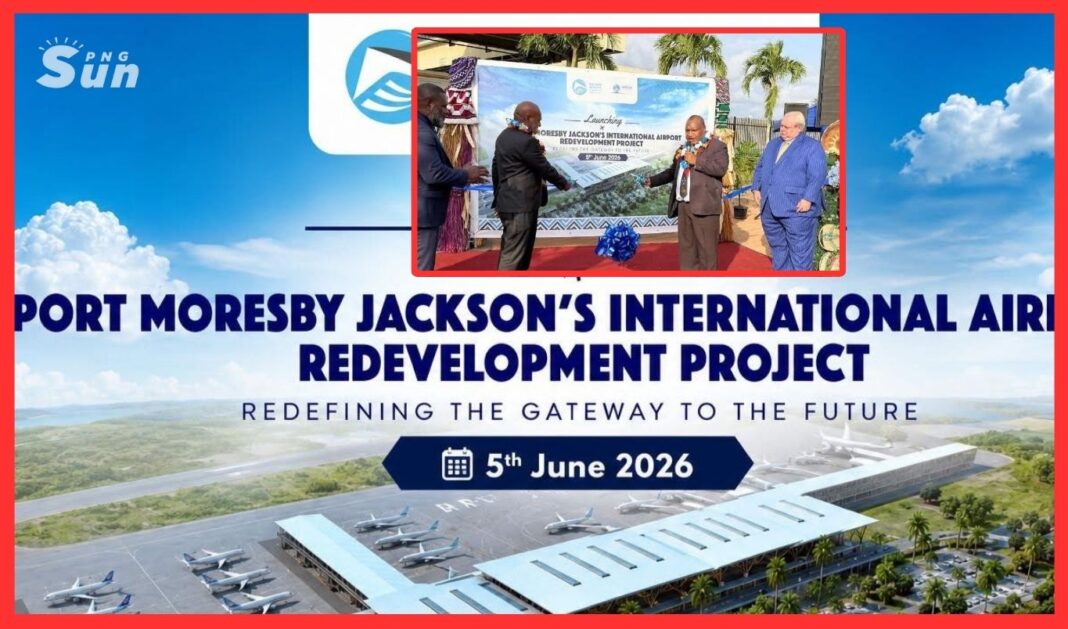

The National Government and the National Airports Corporation (NAC) last Friday launched a K2.5 billion redevelopment and expansion program for Port Moresby International Airport, marking the start of one of the largest aviation infrastructure projects in Papua New Guinea’s history.
Acting Managing Director and Chief Executive Officer of NAC, Mr. Dominic Kaumu, said the redevelopment would be delivered over four phases during the next six-and-a-half years to address growing passenger demand, ease congestion, and modernize the country’s main aviation gateway.
Related news: https://www.postcourier.com.pg/nac-launch-redevelopment-project-of-port-moresby-jacksons-international-airport/
Mr. Kaumu said the project would strengthen Papua New Guinea’s position as a regional aviation hub while providing the capacity needed to accommodate projected increases in domestic and international air travel over the coming decades.
The redevelopment will be delivered in four phases over a six-and-a-half-year period, with the immediate priority in Phase One to extend the Domestic Terminal by 110 meters to address current congestion and operational challenges.
Phase One will also include upgrading of the airfield ground lighting (AGL) and power supply systems.
Passenger growth and increasing demand for air travel are the key drivers of the redevelopment.
At Port Moresby International Airport, annual passenger movements have grown from 779,039 in 1997 to 1.68 million in 2025, an increase of almost one million passengers over 28 years.
Mr. Kaumu said passenger volumes at the airport are projected to reach 2.5 million by 2035 and 3.7 million by 2045 based on a four per cent annual growth rate, requiring significant investment in terminal infrastructure to meet future demand.
Across NAC’s 22 airports, passenger movements increased from 1.9 million in 1997 to 3.04 million in 2025, with projections of 4.4 million by 2035 and 6.6 million by 2045.
Phase Two will focus on reconfiguring and expanding the Domestic Terminal under the Civil Aviation Development Investment Program (CADIP III), including new check-in counters, aerobridges, baggage handling systems, VIP lounges, concession areas and facilities for persons with disabilities.
Phase Three will involve expansion of the main apron areas to accommodate Air Niugini’s new fleet of Airbus A220 and Boeing 737 aircraft.
Phase Four includes construction of a new international terminal featuring modern passenger-processing technology, self-check-in facilities, upgraded baggage screening systems, expanded commercial space and enhanced security screening.
The phase will also include extension of the runway from 2,750 meters to 3,500 meters, new taxiway infrastructure, cargo and maintenance facilities, and renewable energy systems through public-private partnership arrangements.
Since transitioning from military to civilian operations in 1945, Port Moresby International Airport has undergone several major upgrades, including terminal developments in 1963, improvements for the 2015 Pacific Games and the opening of the APEC Terminal in 2018.
Mr. Kaumu said the redevelopment project would enhance airport capacity and operational efficiency, improve passenger experience, support Papua New Guinea’s preparations for APEC 2033, and facilitate long-term growth in aviation, trade and tourism.