

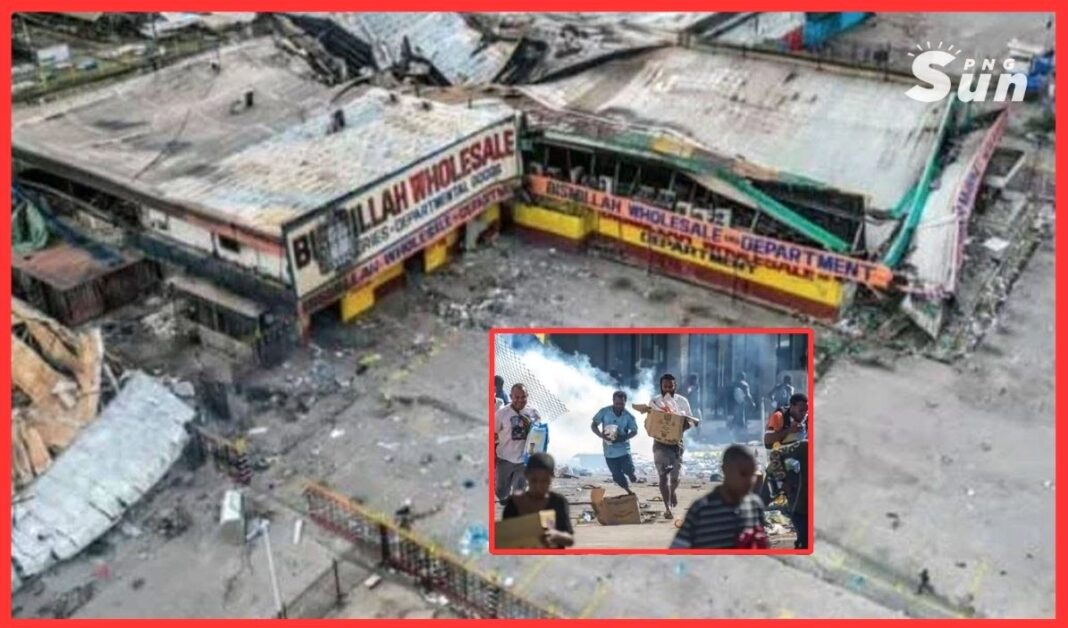

Prime Minister, James Marape has formally received the Final Report of the Commission of Inquiry (COI) into the January 10, 2024, riots in Port Moresby.
He described the findings as “deeply sobering” and central to restoring integrity, professionalism, and public confidence in the Royal Papua New Guinea Constabulary (RPNGC).
Related article: https://www.postcourier.com.pg/marape-receives-coi-report-into-the-2024-black-wednesday/
The report was presented at Melanesian Haus by COI Chairman Justice Ellenas Batari, concluding an extensive investigation into the events widely referred to as “Black Wednesday”.
Prime Minister Marape thanked Justice Batari and his team for completing the inquiry under difficult circumstances, acknowledging the personal sacrifices involved.
“This was not an easy inquiry,” he said. “On behalf of the Government and the people of Papua New Guinea, I thank the Commission for its courage, independence, and commitment to country.”
He said the January 10 riots represented one of the most serious breakdowns of public order in recent history, involving unlawful conduct by some police officers that escalated into widespread looting and destruction across Port Moresby.
However, the Prime Minister stressed that the Inquiry was deliberately mandated to go beyond a single incident.
“This was about leadership, discipline, governance, and accountability within the police force as a whole,” he said.
Justice Batari outlined entrenched structural and operational weaknesses within the RPNGC, including failures in command and control, weakened discipline, poor governance, mismanagement of resources, and external interference. He noted that these problems were cumulative and not attributable to any single government.
Prime Minister Marape noted that many of the concerns identified in the Commission’s findings echoed warnings raised more than two decades ago in the 2004 Police Review Report led by Hon. Bire Kimisopa, which highlighted declining discipline, weak leadership, poor resourcing, and eroding public confidence within the RPNGC.
He said that while the Bire report had set out clear and practical recommendations to professionalize and rebuild the police force, no government since then had seriously or consistently invested in developing the Constabulary, allowing standards, capacity, and morale to steadily erode over time.
Prime Minister Marape said the Government accepts the findings and will ensure the report is fully acted upon.
“This is not about targeting individuals. It is a blueprint for rebuilding the police force Papua New Guinea needs,” he said in a statement.
He emphasised that effective policing underpins the entire law and justice system, from prosecutions to the courts, and noted that some corrective actions had already begun during the Inquiry process.
The Prime Minister also highlighted the frequent turnover of Police Commissioners — nearly 20 in 50 years — as a major cause of institutional instability.
“You cannot reform an institution with constantly changing leadership,” he said.
He confirmed that the report will be considered by Cabinet and tabled in Parliament to ensure transparency and public accountability.
“The people deserve to know what went wrong and how we intend to fix it,” he said.
Prime Minister Marape said the report’s release during Papua New Guinea’s 50th Anniversary of Independence was significant.
“January 10 was a dark moment in our history,” he said. “But we will use it to strengthen our police force and restore public trust.”
He said work on implementing reforms will continue ahead of the 2027 General Election.
“It is not the election that matters most,” he said. “It is the work we do between now and then.”