

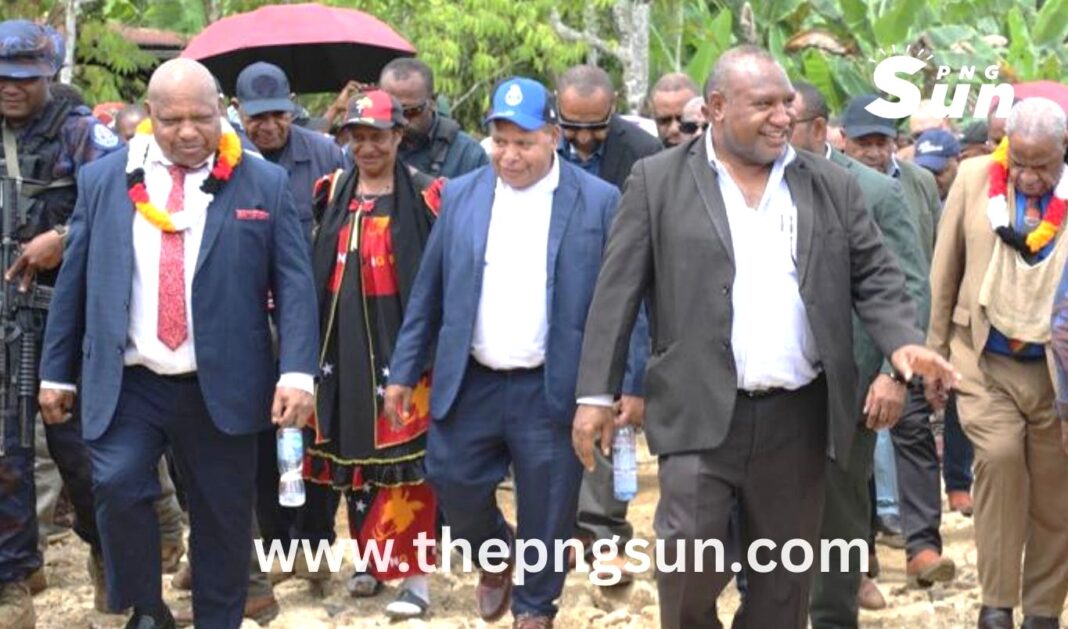

Prime Minister, James Marape has led a powerful act of traditional reconciliation and national justice in Poroma, Southern Highlands Province, as communities moved to restore peace following the killing of police officer, the late George Apon of Poroma.
The late Apon was a senior police officer from Poroma who was shot and killed in Tari, Hela Province, in December 2024.
The Prime Minister visited Poroma on Thursday accompanied by Hela Governor Hon. Philip Undialu, Southern Highlands Governor Hon. William Powi, Nipa-Kutubu MP Hon. Billy Joseph, council presidents, LLG presidents and community leaders. They witnessed a customary compensation and peace mediation ceremony between leaders from Tari-Pori and Nipa-Kutubu.
As part of the reconciliation process, pigs, cattle and cash were presented to the bereaved family, reflecting Papua New Guinea’s traditional systems of justice, peace-making and restoration.
Prime Minister Marape said the ceremony marked a significant step in healing divisions caused by violence and reaffirmed the importance of PNG Ways in maintaining harmony across communities.
“What we witnessed in Poroma was PNG at its best — leaders, families and communities coming together to heal wounds, restore dignity and keep the peace,” Prime Minister Marape said.
He said his involvement in peacebuilding between Nipa, Tari-Pori, Hela and Mendi communities’ dates back nearly two decades.
“Since 2007, I have been personally involved in making peace between Nipa and Tari, between Pori, Hela and Mendi. Even as Prime Minister, under PNG Ways, I still have a duty of care to be among communities when they are making peace,” he said.
“This is not just a political role — it is a cultural and moral responsibility.”
Prime Minister Marape said the reconciliation process is anchored in Directive Principle Five of the National Constitution, which recognizes PNG Ways as central to governance.
“Our Constitution reminds us that we are not simply a Western society. We are Melanesians. Our traditions of mediation, compensation, reconciliation and mourning have kept our communities together for thousands of years,” he said.
“These systems must not be abandoned — they must be strengthened.”
The Prime Minister also commended the people of Tari-Pori for arresting and handing over two suspects accused of killing a Hope Institute teacher last year.
“The community is tired of violence. They want peace and they are now working with the police, not against them,” he said.
The suspects are now in police custody and awaiting prosecution, while informants who assisted in their arrest are being recognized.
Prime Minister Marape said those responsible for murder must face the full force of the law.
“These crimes create widows, fatherless children and grieving families. Those responsible must receive the maximum penalty allowed under the law,” he said.
He emphasized that customary reconciliation would proceed alongside formal court processes.
“Customary processes restore peace in the community. The courts deliver justice for the crime. Both must work together.”
The Prime Minister also urged young people across Hela, Southern Highlands and Papua New Guinea to reject violence.
“Violence only creates more violence. If you have a dispute, seek mediation, go to village courts, district courts or national courts. Do not take the law into your own hands — because you will be arrested and prosecuted,” he said.
Prime Minister Marape said the Poroma ceremony demonstrated how traditional leadership, churches and modern law enforcement can work together to build peace from the ground up.
“This is how we keep Papua New Guinea together — through our culture, our Constitution and our commitment to one another,” he said.