

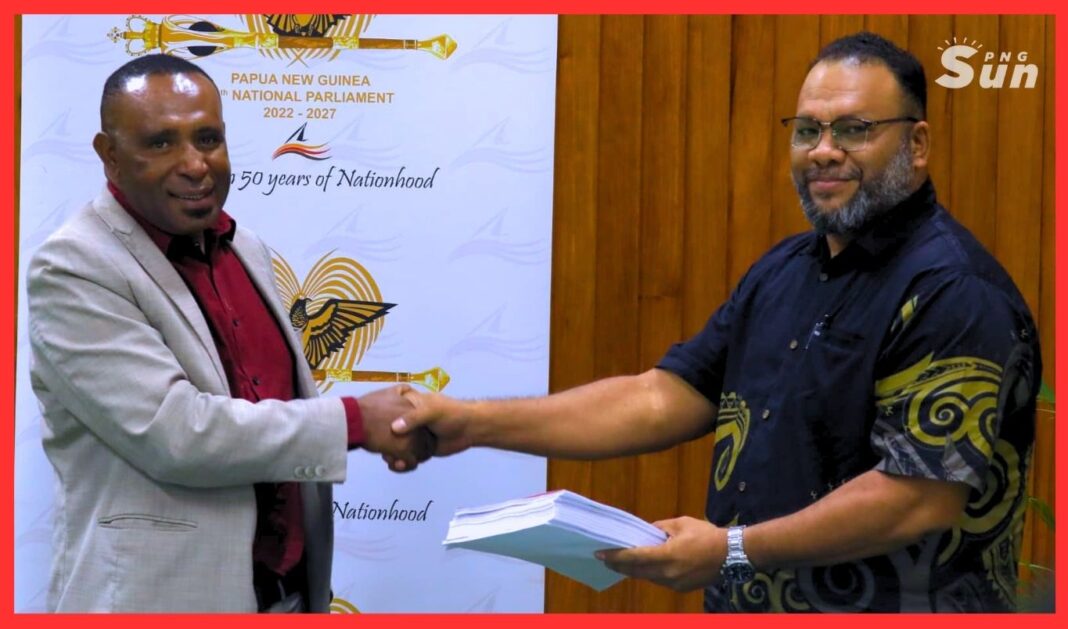

The President of the Media Council of Papua New Guinea, Neville Choi, has welcomed the parliamentary report on journalism standards, describing it as the beginning of a new phase for the media sector in the country.
Speaking at press conference during the official handover of the 2026 Report on the Standards and Integrity of Journalism in PNG at the Parliament’s State Function Room, Mr. Choi acknowledged the work of the committee and said the report marks both the end of one phase and the start of another.
Related news: https://www.abc.net.au/pacific/programs/pacificbeat/png-media-law/106510014
Mr. Choi said the hearings conducted by the committee captured honest views from across the country.
“The series of hearings, I think they were very honest opinions given to the committee. And I was thankful to be part of at least one or two of those hearings, regional consultations,” he said.
From the council’s perspective, he said the report comes at a critical time when the media industry is revolving.
“I think what the report shows is that we are at a watershed time of the media. And I think this report would be the catalyst to see a stronger foundation for the media, a stronger pathway for training of journalists, and most importantly, the protection of media personnel while they’re doing their jobs,” he said.
President Choi noted the uniqueness of the process, saying such engagement between government and the media sector is rare.
“I think it must be said that this has never happened in most countries before, where there’s a parliamentary committee that has done its work and has been open to understanding what the media is all about,” he said.
He added that the process signals growing cooperation between stakeholders.
“This signals that there is a collaboration of sorts between industry and government. And I think we all work towards the same end, and that is to help and grow and develop our people,” he said.
Mr. Choi said this includes supporting citizens through economic development, ensuring their protection online, and improving how they engage on social media.
He acknowledged the work of the committee ahead, noting that implementation will require broad participation.
“It is true that now we do have a lot of work ahead of us, and a lot of work that includes the involvement and engagement of not just the media, but most state agencies that are involved in this, as mentioned in the report,” he said.
Mr. Choi said the council is already taking steps toward implementation, including collaboration with key government offices.
“We look forward to working with the Secretary for DICT and the chief censor and other agencies,” he said.
He revealed that initial groundwork has already begun following the tabling of the report.
“Since the report was tabled, we have started on an implementation plan of sorts.
Some of the things that are mentioned in the report we have already started the foundational work for,” he said.
Among these efforts is a new initiative focused on strengthening information integrity.
“The fact-checking aspect, we’ve already started working with partners on what we’re calling the Media Information Integrity Initiative, or M3I,” he said.
Mr. Choi explained that the initiative is aimed at improving verification processes in newsrooms ahead of upcoming elections.
He emphasized that responsibility now rests with both the media and state agencies.
“We do have a lot of work to do, and I can already tell from the list of recommendations,” he said.
“But it’s good work that we’ve been fighting for several years,” he concluded.