
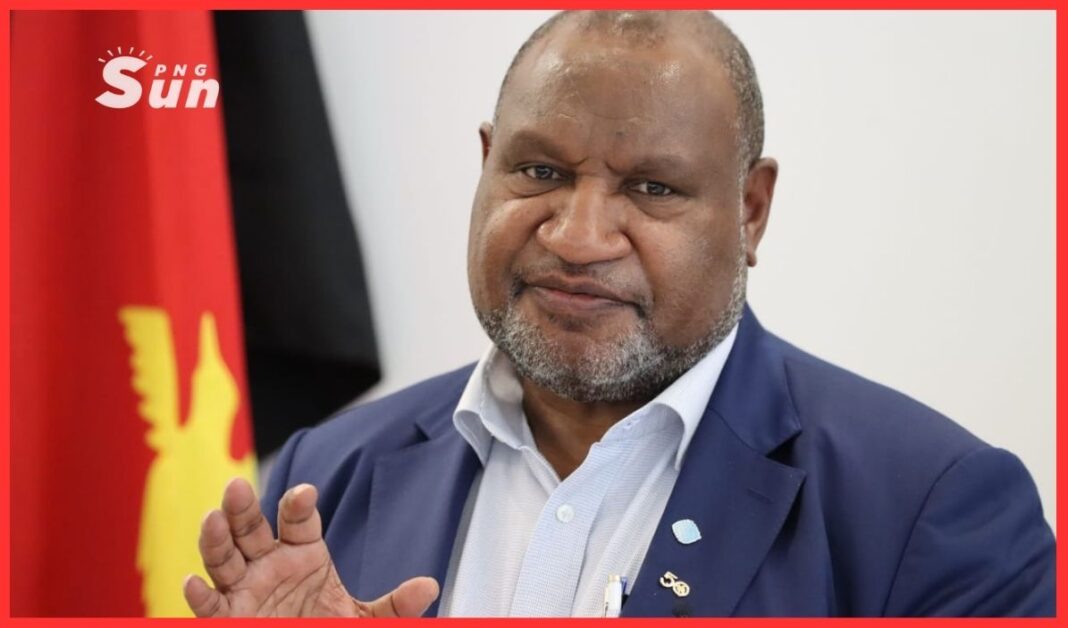

Prime Minister, James Marape has assured Papua New Guineans that the Government is fully prepared to respond decisively should the country be placed on the Financial Action Task Force (FATF) grey list, stressing that Papua New Guinea is in a far stronger position today than during the previous listing in 2015.
Responding to journalist Wanpis Ako’s question, Prime Minister Marape said grey listing was not new to Papua New Guinea and that the Government had already made significant progress in addressing outstanding compliance issues.
Mr. Ako asked PM Marape to give an update on what his government’s policy and legislative interventions to exit the country out of the grey listing.
“This is not the first time Papua New Guinea has faced grey listing. It happened before, and we successfully worked our way out of it,” the Prime Minister told reporters.
He confirmed that the Governor of the Bank of Papua New Guinea and a highly competent technical team are currently engaging with international counterparts, including participation in assessment discussions in Mexico.
“From the briefings I have received, Papua New Guinea now has only about nine outstanding issues. This is far fewer than where we were in 2015, when the country was first grey-listed,” Prime Minister Marape said.
Greylisting of the country is due to money laundering and terrorism funding.
The Prime Minister assured the country that, if Papua New Guinea is grey listed, his government will work “non-stop” to ensure an early exit.
“I want to give assurance to the country that if we do enter the grey list, we will work to get out of it at the very earliest opportunity — just as we did before. It could be within months, not years,” he said.
Prime Minister Marape highlighted major institutional and legislative reforms implemented since 2015, which have significantly strengthened Papua New Guinea’s framework for combating money laundering and related financial crimes.
“Before 2015, there was no Independent Commission Against Corruption. Today, we have ICAC in place. Before 2015, there were gaps in our proceeds of crime laws, particularly in dealing with undisclosed assets. Today, those provisions are embedded in our laws and regulations,” he said.
He added that Papua New Guinea now has stronger mechanisms to detect and address money laundering and to monitor potential terrorist financing risks.
“Our country is not a target for international terrorism financing. However, we are targeted for money laundering, and that is where our focus is. We are tightening our systems and strengthening enforcement across the country,” the Prime Minister said.
Prime Minister Marape said engagement with FATF processes can also be constructive, as it provides clarity on areas that require improvement.
“If there are weaknesses, it helps us identify them clearly. I am focused on growing the economy, but I do not want to grow an economy where the sinkholes remain wide open,” he said.
He confirmed that he has already held high-level meetings with law enforcement agencies, the judiciary, and other key institutions to ensure a coordinated national response.
“If grey listing points us to areas where we need to do better, then we fix them. We tighten the system, strengthen compliance, and come back stronger,” Prime Minister Marape said.
Expressing confidence in Papua New Guinea’s ability to respond swiftly, the Prime Minister said the country’s experience in exiting the grey list previously provides a clear pathway forward.
“We exited earlier than expected in 2015, and we can certainly do so again. Whether it is within two years or even much sooner, we will work tirelessly to ensure Papua New Guinea meets all requirements and maintains the integrity of its financial system,” he said.