

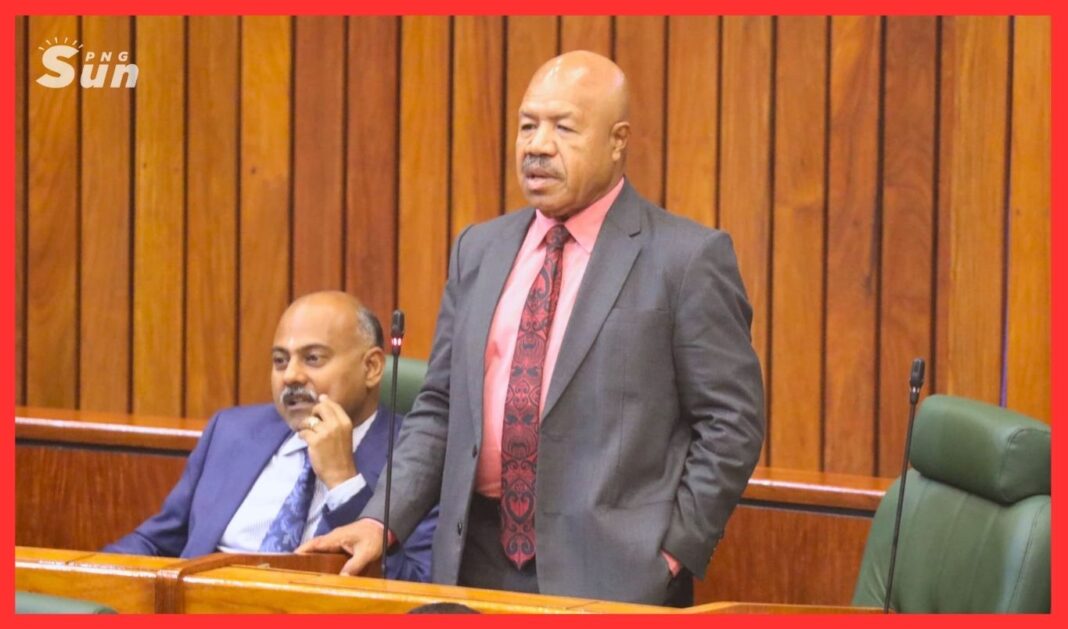

PNG Parliament must uphold peace and stability, respect the Constitution, and honor the Bougainville Peace Agreement when determining the future of the Bougainville Referendum, National Capital District Governor Powes Parkop said during debate on the issue in Parliament yesterday.
Governor Parkop’s remarks followed the presentation of a major report on Bougainville matters by the Parliamentary Bipartisan Committee on Bougainville, chaired by Rabaul MP Dr Allan Marat.
He said public consultations conducted by the committee identified maintaining peace and stability and adhering to constitutional processes as the key principles that should guide Parliament’s deliberations.
Governor Parkop urged fellow Members of Parliament to approach the referendum debate with courage, wisdom and a commitment to securing a peaceful future for both Bougainville and Papua New Guinea, saying the decision would shape the future of the autonomous region and the nation.
Speaking during the parliamentary debate, Governor Parkop acknowledged the significance and sensitivity of the issue, describing it as a decision that will shape the future of Bougainville and the nation as a whole.
“This is a very important discussion that will define both Bougainville’s journey and Papua New Guinea’s future,” Governor Parkop said.
He recognized contributions made by fellow Members of Parliament, noting that the debate requires careful consideration because of the strong emotions and concerns surrounding the country’s unity and future.
Governor Parkop said the Bougainville issue is deeply connected to the painful history of the conflict, which resulted in loss of life and suffering for many people.
However, he highlighted the achievement of lasting peace since the signing of the Bougainville Peace Agreement in 2001.
“We have achieved an unprecedented outcome. We have achieved peace, and we have respected that peace. This is exceptional and something we should be proud of,” he said.
He encouraged Parliament to draw confidence from the success of the peace process and use it as a foundation for making decisions about the future.
Reflecting on Papua New Guinea’s nation-building journey, Governor Parkop noted that the country’s founding leaders faced similar challenges and uncertainties when bringing together diverse cultures, languages and regions to form one nation.
“Building a nation is never easy. It is never perfect, and it is never complete. Yet we have held Papua New Guinea together for 50 years,” he said.
Governor Parkop stressed that the responsibility for deciding the future of the Bougainville Referendum rests with the current Parliament and should not be deferred.
“This Parliament must make the decision. We have been given the privilege and responsibility to determine the future direction of our country,” he said.
Drawing comparisons with international examples, Governor Parkop noted that questions of self-determination and national unity are not unique to Papua New Guinea.
He cited experiences in the United Kingdom and the relationship between China and Taiwan as examples of ongoing nation-building challenges.
He urged leaders not to fear the future but to focus on creating outcomes that are better than the past.
“The most important thing is to think about making the future better than the past,” he said.
Governor Parkop also commended the Parliamentary Bipartisan Committee on Bougainville, chaired by Member for Rabaul Dr Allan Marat, for consulting people across the country and gathering public views on the referendum issue.
Referring to the committee’s findings, he said Papua New Guineans had identified several key principles that should guide Parliament’s decision-making process.
The first principle, he said, is the importance of maintaining peace and stability between the National Government and the Autonomous Bougainville Government.
“Whatever decision we make, we must maintain peace and stability,” Governor Parkop stated.
He acknowledged the commitment shown by Autonomous Bougainville Government President Ishmael Toroama and Bougainville leaders to pursuing peaceful dialogue and constitutional processes.
The second principle highlighted by Governor Parkop was the need to uphold the Constitution and the provisions established under the Bougainville Peace Agreement.
He reminded Parliament that the Constitution was amended following the 2001 peace settlement and that all decisions regarding the referendum should remain within that constitutional framework.
Governor Parkop said Papua New Guinea and Bougainville had demonstrated an exceptional commitment to honoring the Peace Agreement over the past two decades.
“We have honored the agreement and the Constitution. This is unprecedented and should give us confidence that we can reach a good decision together,” he said.
Concluding his remarks, Governor Parkop urged Parliament to proceed with the referendum process, allowing the results to be formally presented and debated in the House.
He expressed confidence that, regardless of the final decision, goodwill exists between Papua New Guinea and Bougainville to negotiate a peaceful and mutually acceptable outcome.
“I believe we can reach an outcome that secures a better future for all our people and for the people of Bougainville,” Governor Parkop said.