
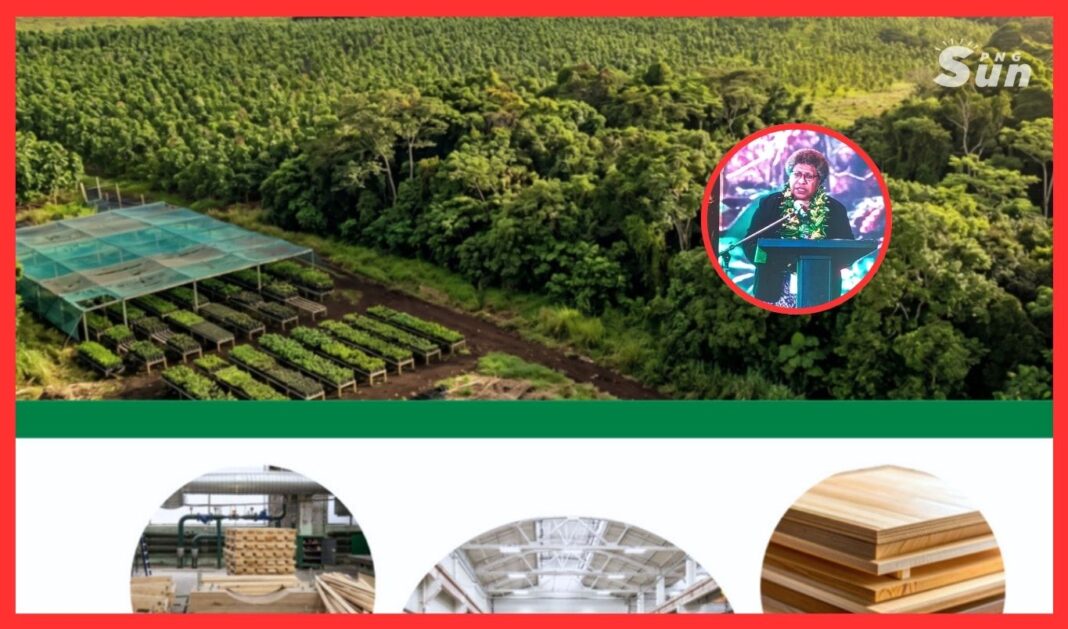

The Secretary for the Department of International Trade and Investment, Mrs. Jacinta Manua has reaffirmed the government’s commitment to transforming Papua New Guinea’s forestry sector through downstream processing and Special Economic Zones (SEZs).
Speaking at the National Forestry Forum yesterday at the Apec Haus, Mrs. Manua said the logging industry has operated in the country for more than 50 years, contributing significantly to government revenue, landowner royalties, and infrastructure development.
Related news: https://pnghausbung.com/sez-is-the-way-forward-minister-maru/
However, she said the country’s continued reliance on raw log exports has limited the long-term benefits of the forestry sector.
“If we remain in this status quo, we will not fully realize the full value of the forestry sector,” Mrs. Manua said.
She said the Marape-Rosso Government is now prioritizing downstream processing to increase value addition, create employment opportunities, and strengthen participation by local businesses and SMEs.
Mrs. Manua explained that Special Economic Zones are expected to play a key role in driving downstream processing and attracting investment into forestry and manufacturing industries.
She noted that countries such as Indonesia, Malaysia, Thailand, and the Philippines have successfully used Special Economic Zones to develop downstream industries and expand their economies.
“We realize now that if there is a vehicle for us to bring investment into the country and integrate domestic investors into the economy through downstream processing, it has to be Special Economic Zones,” she said.
Mrs. Manua said Papua New Guinea already has the policy foundation to support the initiative through the Special Economic Zone Act and related development plans currently being worked on by her department.
She said downstream processing would not only create jobs and increase government revenue but would also promote environmental sustainability by reducing overharvesting and encouraging better resource management.
The secretary also highlighted growing international market requirements for sustainable and certified forestry products, including regulations introduced by the European Union, Australia, New Zealand, and the United States.
She said Papua New Guinea must align with global environmental and trade standards to maintain market access for its forestry products.
“As we talk about downstream processing, we also talk about green industry,” Mrs. Manua said.
She said green industries and low-carbon supply chains are becoming major drivers of global economic growth, and Papua New Guinea must position itself to benefit from this transition.
Mrs. Manua emphasized the importance of smart technology, renewable energy integration, digital monitoring systems, and eco-friendly processing methods within Special Economic Zones.
She also called for stronger cooperation between government agencies, private sector companies, development partners, and communities to ensure successful implementation of downstream forestry projects.
The secretary stressed the need for training and capacity building for landowners, youth, and local entrepreneurs so they can actively participate in forestry development and value-added industries.
She acknowledged ongoing collaboration between the Department of International Trade and Investment and the Papua New Guinea Forest Authority to develop national standards for green forestry products.
Mrs. Manua said the downstream processing is not only about increasing the value of timber products but also about creating long-term economic opportunities for Papua New Guinea and future generations.
“The Special Economic Zone model gives us the platform to transform forestry into a sustainable, innovative, and resilient industry,” she said.
Related news: https://www.thepngsun.com/png-forestry-authority-hosts-national-forum-to-gauge-views-for-legal-policy-reforms/
She added that her department stands ready to work closely with PNGFA and stakeholders to ensure the country’s transition from raw log exports to value-added processing is inclusive and beneficial for all Papua New Guineans.