

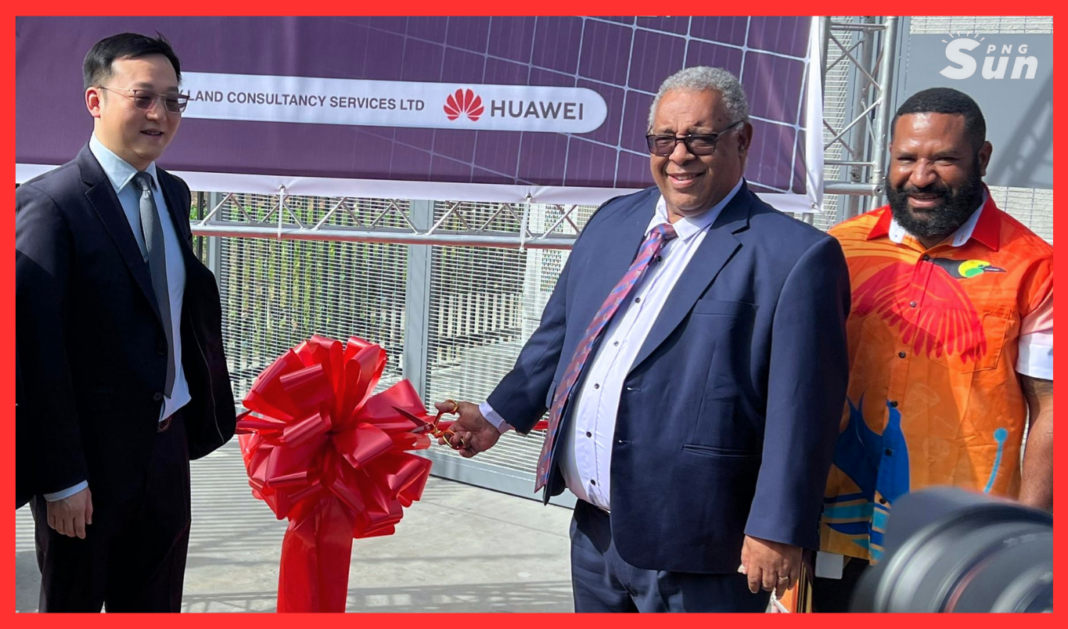

The PNG Prime Minister’s Office on Friday launched a solar and Battery Energy Storage System (BESS) at its Waigani headquarters in Port Moresby as the Government pushes to reduce reliance on diesel-powered electricity.
Key officials attending the launch included National Energy Authority Managing Director Mr. Ronald Meketa, Huawei PNG Chief Executive Officer Mr. Angelo Zhang, National Monitoring and Coordination Authority CEO David Wereh and Chief Secretary to Government Mr. Ivan Pomaleu.
Related news: https://pnghauslain.com/chief-secretary-launches-new-solar-battery-system-at-melanesian-haus/
Speaking at the launch, Mr. Meketa said the establishment of the National Energy Authority had changed the country’s energy sector by separating regulation from power generation, a role previously dominated by PNG Power Ltd.
“We never had an energy regulator five years ago. PNG Power was the player and the referee at the same time. You cannot be a referee and a player,” Mr. Meketa said.
He explained that while PNG Power Ltd is licensed to operate only 36 centers nationwide, the country has more than 119 centers, leaving many communities outside the national grid.
Mr. Meketa said the Government is now encouraging provinces and districts to develop their own energy systems through renewable sources such as solar, wind, geothermal and hybrid generation.
Mr. Meketa explained that people and businesses in areas served by PNG Power can install solar systems for their own electricity use, but they cannot sell power back to the main grid unless they have an official agreement in place.
“We are encouraging Port Moresby residents and business houses with rooftop space or extra land to install solar with battery systems for their own use,” he said.
He said PNG aims to cut down on expensive diesel use, as PNG Power currently spends close to K400 million on fuel each year.
“By 2030, if we move towards 100 percent renewable energy, PNG Power could save almost K400 million in fuel costs every year,” Mr. Meketa said.
Mr. Meketa added that Port Moresby’s power system is expected to become fully renewable within the next five years, supported by hydro projects and expanding solar investments.
Meanwhile, CEO Mr. Zhang said the new battery storage system worked well during testing and can switch from the main power supply to backup power within milliseconds without causing blackouts.
“We can proudly say Huawei is the only supplier capable of achieving such seamless switching, ensuring power is restored within milliseconds during outages,” Mr. Zhang said.
Mr. Zhang said the project demonstrated how solar energy combined with advanced battery storage can improve energy reliability while reducing dependence on diesel generation.
He said Huawei has already established similar renewable energy projects in communities and business areas around the country, including small power systems for remote islands not connected to the national grid.
Chief Secretary Pomaleu described the launch as an important step for the public service and the country’s electricity supply system.
“This setup will significantly reduce electricity costs for the Department while ensuring essential operations continue during power outages,” Mr. Pomaleu said.
Mr. Pomaleu said the project supports the Government’s plans to improve service delivery, expand rural electrification and meet Papua New Guinea’s climate commitments under the Paris Agreement.
He also urged PNG Power and private investors to work closely with the National Energy Authority to expand renewable energy projects and strengthen the country’s electricity transmission and distribution systems.
“Power enables other things to happen. It enables communications, businesses and economic opportunities for our citizens,” he said.
The event well ended with a ribbon-cutting ceremony to officially launch the system.