

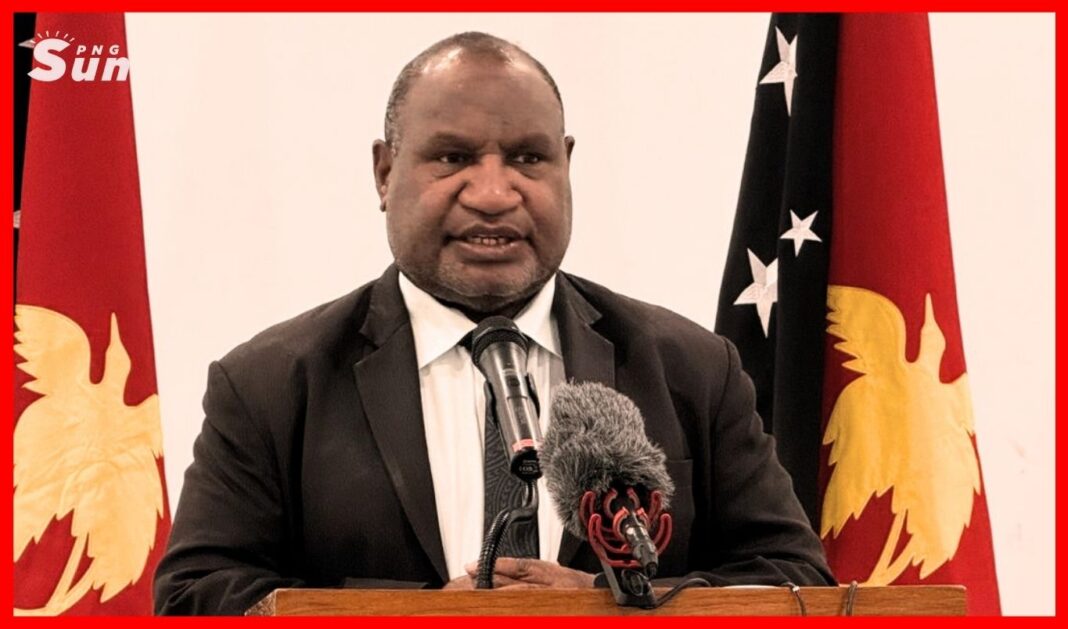

PNG Prime Minister James Marape has rejected claims that Papua New Guinea reaffirmed its One China Policy under political or economic pressure, insisting the decision was a sovereign one based on the country’s long-standing foreign policy and national interests.
Responding to comments by Taiwan Foreign Minister Lin Chia-lung following Papua New Guinea’s decision to close Taiwan’s representative office, PM Marape said the Government’s position was reached through constitutional processes and reflected nearly five decades of consistent policy.
“Papua New Guinea is an independent and sovereign nation.”
“Our foreign policy is determined by our national interests and by decisions made through our constitutional processes—not by pressure from any external power,” he said in a statement this evening.
PM Marape said Papua New Guinea had maintained its One China Policy since 1976, recognizing the Government of the People’s Republic of China in Beijing as the sole legitimate government of China.
He said Cabinet had carefully considered the matter before reaffirming the policy, describing it as consistent with the country’s long-established diplomatic position, international law and the principles of the United Nations Charter.
“We recognize and respect China’s sovereignty and territorial integrity, just as we expect all nations to respect Papua New Guinea’s sovereignty and territorial integrity,” he said.
The Prime Minister said Papua New Guinea had no intention of becoming involved in the cross-Strait dispute between Beijing and Taipei.
“The issues between Beijing and Taipei are matters for those directly concerned to resolve peacefully.”
“Papua New Guinea does not intend to become entangled in issues that fall outside our jurisdiction or our national interests,” he said.
PM Marape also dismissed suggestions that the Government had acted under coercion.
“To suggest that Papua New Guinea has acted under pressure is to underestimate our independence as a nation.”
“We made this decision because it is consistent with our own national interests, our foreign policy principles and our long-standing diplomatic position,” he said.
Responding to comments that Taiwan could review imports of Papua New Guinea’s liquefied natural gas, PM Marape said commercial decisions were matters for the contracting parties.
“If Taiwan chooses to review its commercial arrangements, including LNG purchases, that is entirely a matter for Taiwan and the contracting parties,” he said.
“Papua New Guinea will not be intimidated by suggestions of economic retaliation for exercising our sovereign right to determine our own foreign policy.”
PM Marape said Papua New Guinea remained confident in the strength and diversity of its export markets, noting that during recent bilateral talks, Chinese President Xi Jinping and Premier Li Qiang had expressed China’s willingness to expand imports of PNG products, including LNG, agricultural produce, fisheries products and timber.
He said while Papua New Guinea valued its friendship with all economies, including Taiwan, foreign policy decisions would always be guided by the national interest rather than commercial considerations.
“We respect the people of Taiwan and acknowledge the longstanding people-to-people and commercial interactions that have existed over the years.”
“However, sovereign foreign policy decisions must always be based on the national interest, not on the prospect of economic reward or the fear of economic consequences,” he said.
PM Marape reaffirmed that Papua New Guinea would continue to uphold its longstanding One China Policy while maintaining friendly relations with all countries based on mutual respect, peaceful cooperation and international law.