

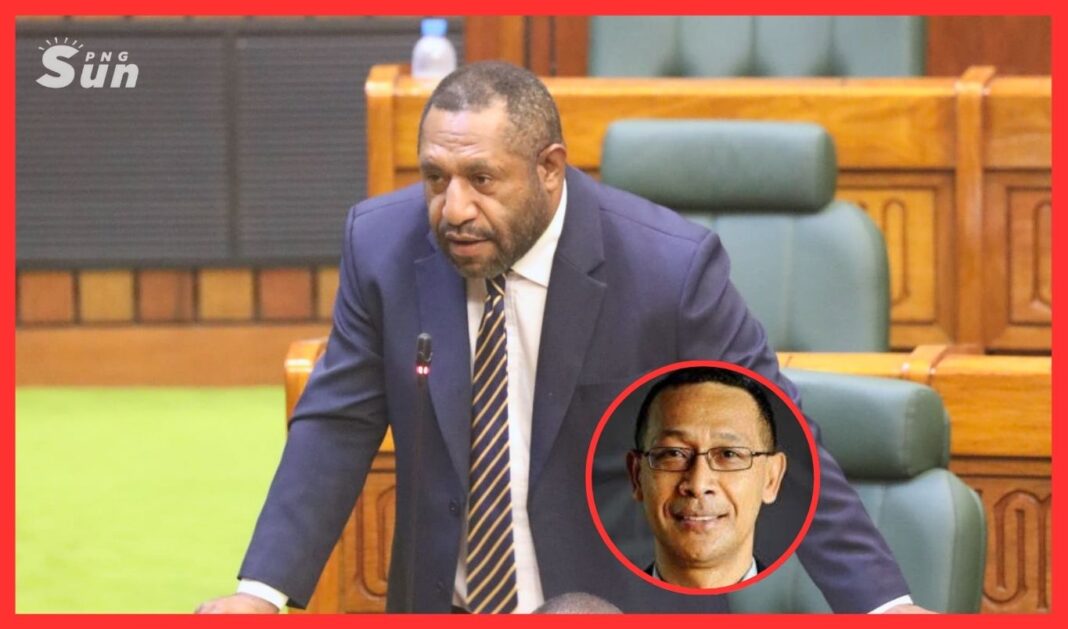

Treasurer Ian Ling-Stuckey has defended the government’s economic reform program in Parliament amid concerns over the impact of foreign exchange reforms, currency depreciation and fluctuating economic indicators on inflation, investor confidence and household purchasing power.
The Treasurer’s response came after Kundiawa-Gembogl MP Muguwa Dilu questioned the effectiveness of IMF-supported reforms during Parliament yesterday.
Related news: https://thepngbulletin.com/news/dilu-demands-proof-if-imf-reforms-are-working/
He was arguing that the weakening Kina had increased the cost of obtaining foreign currency and contributed to rising inflation and reduced purchasing power for Papua New Guineans.
Mr. Dilu also called for greater scrutiny of the reforms, questioning whether improvements in export earnings reflected genuine growth in production or were largely driven by higher global commodity prices, while raising concerns about investor confidence, capital flows and the country’s balance of payments position.
Mr. Dilu said the weakening Kina had made it more expensive to obtain Australian and US dollars and argued that the policy needed to be assessed against clear evidence of economic improvement.
He also questioned whether export volumes had actually increased, suggesting that any rise in export earnings may be linked to higher global commodity prices rather than stronger production.
He further raised concerns over the balance of payments and capital account trends, asking whether investors were shifting funds offshore due to declining confidence in the economy.
The MP also queried whether increased currency trading activity reflected capital flight and attempts by investors to profit from the kina’s depreciation.
In response, Treasurer Ian Ling-Stuckey acknowledged mixed movements in key economic indicators but defended the broader direction of the reform program.
He said export earnings had fluctuated in recent years, recording K51 billion in 2022, falling to K46 billion in 2023, before rising again to K51.7 billion in 2024.
He added that while the figures showed variation rather than steady growth, the overall trend reflected resilience in the export sector under challenging global conditions.
The Treasurer also noted that the balance of payments had moved from K2.8 billion in 2022 to K199 million in 2023, before increasing slightly to K238 million in 2024.
He further highlighted that the current account had declined from K16.1 billion in 2022 to K10.1 billion in 2023, before rebounding strongly to a record K18.4 billion in 2024.
Hon. Ling-Stuckey said despite concerns over currency depreciation and fluctuating indicators, Papua New Guinea’s foreign exchange reserves had strengthened, rising to more than K14.6 billion by the end of 2024.
While acknowledging the concerns raised in Parliament, the Treasurer said he would provide further detailed responses on capital flows and investor behavior at a later date.