

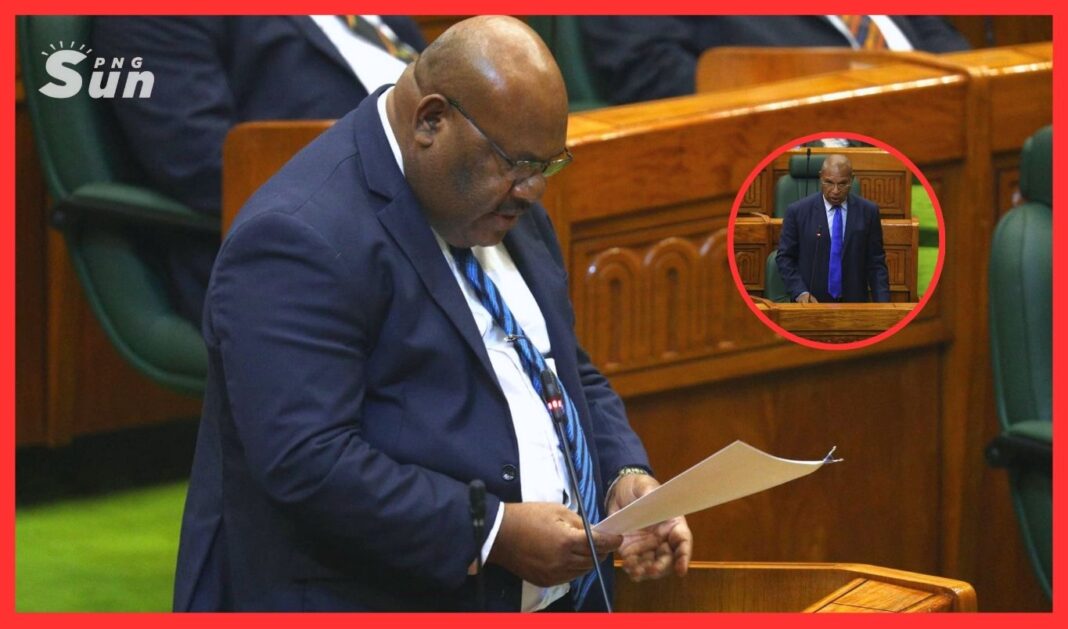

Talasea MP Freddy Reu Kumai has raised concerns in Parliament over the growing dominance of foreign conglomerates in West New Britain Province, claiming local businesses are being pushed out of major commercial opportunities.
During Question Time yesterday, Mr. Kumai directed a question without notice to International Trade and Investment Minister Richard Maru and called on the Commerce and Industry, and the Labour and Migration Ministers to take note of the issue.
Related news: https://www.postcourier.com.pg/kumai-raises-concerns-over-foreign-companies-in-west-new-britain/
He alleged that foreign companies linked to Sime Darby, the operator of New Britain Palm Oil Limited (NBPOL), were taking over construction, civil works, oil palm replanting, and excavation contracts that were previously handled by local contractors and small businesses in West New Britain.
Mr. Kumai warned that the situation was creating what he described as a monopoly, leaving local Papua New Guinean businesses unable to compete and reducing economic benefits for communities in the province.
He explained that for more than 40 years, local West New Britain–based contractors and small and medium enterprises (SMEs) had meaningfully participated in construction, civil works, oil palm estate replanting, and excavation projects associated with New Britain Palm Oil Limited (NBPOL). These activities had provided significant employment, income, and a pathway for local people to build sustainable enterprises.
However, Mr. Kumai said recent developments indicate that several foreign conglomerates linked to or contracted under Sime Darby had taken over many of these commercial opportunities.
He said the companies were now dominating construction and civil works, oil palm replanting, and excavation contracts, creating a de facto monopoly and marginalizing local businesses in West New Britain Province.
“Our people in West New Britain Province are deeply concerned that local companies can no longer compete with these large foreign entities,” he said.
Mr. Kumai further claimed that profits and benefits were being taken out of the province and the country instead of circulating within local communities.
He argued that the trend undermined Papua New Guineans’ rights to participate in business activities in their own country, as envisaged under the Constitution and national development policies.
The Talasea MP also questioned whether the companies involved were properly registered as foreign or Papua New Guinean entities, whether they complied with PNG laws and regulatory requirements, paid the correct taxes, lodged annual company returns, and employed foreign workers with valid work permits.
He said that because NBPOL operates plantations, mills, and cattle crossing businesses in West New Britain, subcontracting opportunities once enjoyed by local operators had now largely been absorbed by foreign conglomerates.
“This is not merely a commercial dispute,” Mr. Kumai said. “It is about protecting and securing the business rights of Papua New Guineans in West New Britain Province now and into the next 50 years, consistent with the spirit and intent of our Constitution and national economic empowerment policies.”
Mr. Kumai asked whether the Government was aware of the growing dominance of foreign conglomerates contracted under Sime Darby and whether it recognized the displacement of local businesses from sectors such as construction, civil works, oil palm estate replanting, and excavation.
He also called on the Government to direct agencies including the Department of Commerce and Industry, Department of International Trade and Investment, Investment Promotion Authority, Internal Revenue Commission, PNG Customs Service, and Department of Labour and Immigration to conduct a full investigation and audit in West New Britain.
The proposed investigation would determine whether the companies were properly registered, whether they were subsidiaries or related entities of the Sime Darby conglomerate, whether they complied with tax and company laws, and whether all foreign workers held valid work permits.
Mr. Kumai said that if breaches of PNG laws or evidence of unfair displacement of local businesses were found, the Government should take corrective action to restore commercial opportunities for Papua New Guinean-owned companies.
He further urged the Government to strengthen policies and regulations aimed at protecting local business participation under the Government’s “Take Back PNG” economic empowerment agenda.
In response, Minister Maru said his office was not previously aware of the allegations.
“Firstly, I want to state on record that my office is not aware of these allegations. This is the first time I’ve heard about it,” Mr. Maru said.
He asked Mr. Kumai to submit the complaint formally in writing and identify the companies involved so the Government could assess the allegations and, if necessary, send a full investigation team to West New Britain.
Minister Maru described the allegations as serious and said the Government would act if the claims were substantiated.
“As a responsible Government, like we did in the case of the Eastern New Britain oil palm growers’ complaint, we took it to court and secured K20 million for the growers,” he said.
“We are going to deal with it. So please bring the complaint to me in writing, and I want to assure you in Parliament, we are going to deal with it as soon as possible.”