

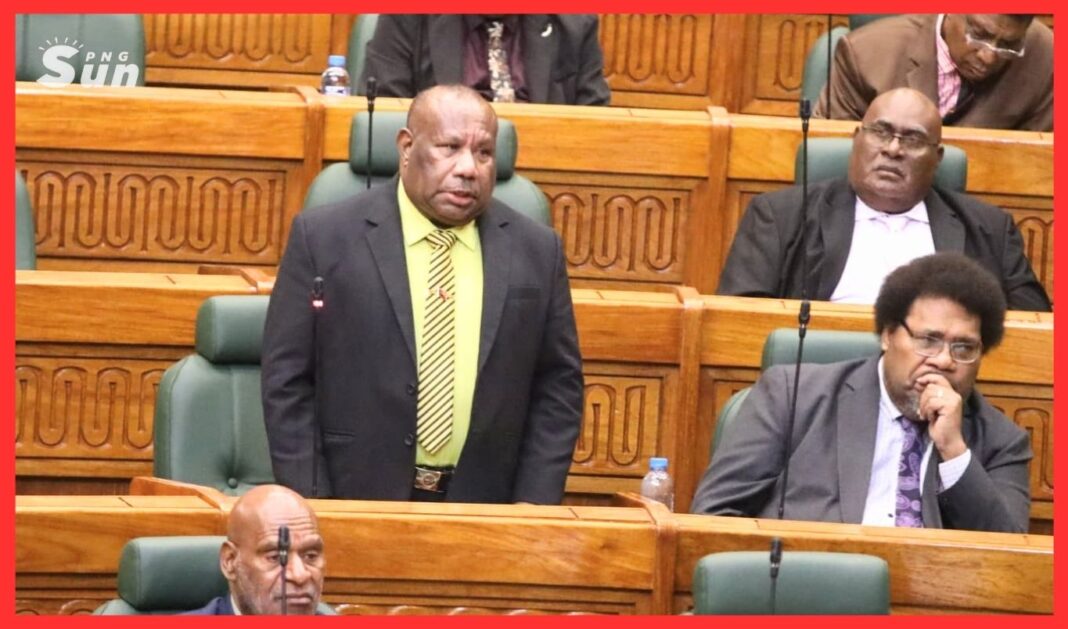

Minister for Public Service, Joe Sungi said the new Dayforce Version 24 system will eliminate manual processes and create audit trails to stop ghost workers, duplicate employee records, and payroll fraud.
He was responding to the questions asked by Northern Governor, Gary Juffa over the government’s engagement of Dayforce to manage the public service payroll system.
Governor Juffa noted that, according to media reports, the government recently entered into a Master Service Agreement with Dayforce Limited to replace and modernize the government payroll system.
Related news: https://www.postcourier.com.pg/ghosts-still-haunt-govt-payroll-juffa-says/
Governor Juffa asked the Minister to explain how the new Dayforce system would identify and remove ghost workers, duplicate employee records, and other fraudulent entries highlighted in the Deloitte audit.
He also asked what safeguards would be built into the system to prevent unauthorized allowances, salary adjustments, and manual payroll manipulations from being entered and processed.
The Governor further questioned what immediate measures are currently in place to prevent ongoing payroll fraud and the leakage of public funds while the new system is still being implemented.
However, Minister Sungi announced that’s an agreement between Dayforce Australia and the Government of Papua New Guinea had been finalized.
He said the agreement now provides a pathway for the complete transfer of payroll responsibilities from the Department of Finance to the Department of Personnel Management.
According to the Minister, most of the Governor’s concerns are addressed in the upgraded payroll platform, which will move from Version 12 to Version 24.
He explained that the new Version 24 system captures almost everything raised by the Governor and will eliminate many manual processes.
The system has already undergone testing and is expected to provide stronger controls and greater accountability.
He described the process as a long journey and assured Parliament and the public that careful consideration had been given to the high risks involved in ensuring the new system is reliable and technically capable of managing the payroll of public servants across the country.
The Minister noted that the government currently spends between K200 million and K300 million every fortnight to pay approximately 130,000 to 160,000 public servants nationwide.
Under the current arrangement, a single action can release those payments to public servants’ bank accounts.
He said the new system, scheduled for implementation later this month, will be formally transferred from the Department of Finance to the Department of Personnel Management.
As an example, the Minister explained that Pay Variation Advice (PVA) forms submitted by HR officers for salary adjustments or deductions will no longer be processed manually.
Instead, they will be managed electronically through the upgraded platform.
He compared the system to the Integrated Financial Management System (IFMS) currently used by the Department of Finance.
Similar to IFMS, the new payroll system will operate through secure electronic processes rather than paper-based approvals.
The Minister said authorized officers will use passwords and secure access controls, allowing the system to record exactly which officer approved a transaction.
This will create an audit trail capable of identifying instances of fraud, duplicate records, or other irregularities.
He stressed that the new payroll platform would significantly reduce opportunities for manual manipulation and improve transparency and accountability throughout the payroll process.
Minister Sungi described the rollout of the new Dayforce payroll system as a decisive step in implementing the Deloitte audit findings and strengthening public sector governance.
The Minister thanked the Prime Minister, the Government, the Governor, and the Chairman of the Public Sector Reform Committee for their support in advancing the implementation of the Deloitte report recommendations.
The Minister encouraged fellow ministers, governors, and public servants to support HR officers as they prepare to operate the new system when it becomes fully operational.
He also thanked the Governor and acknowledged that the questions raised were highly technical.