

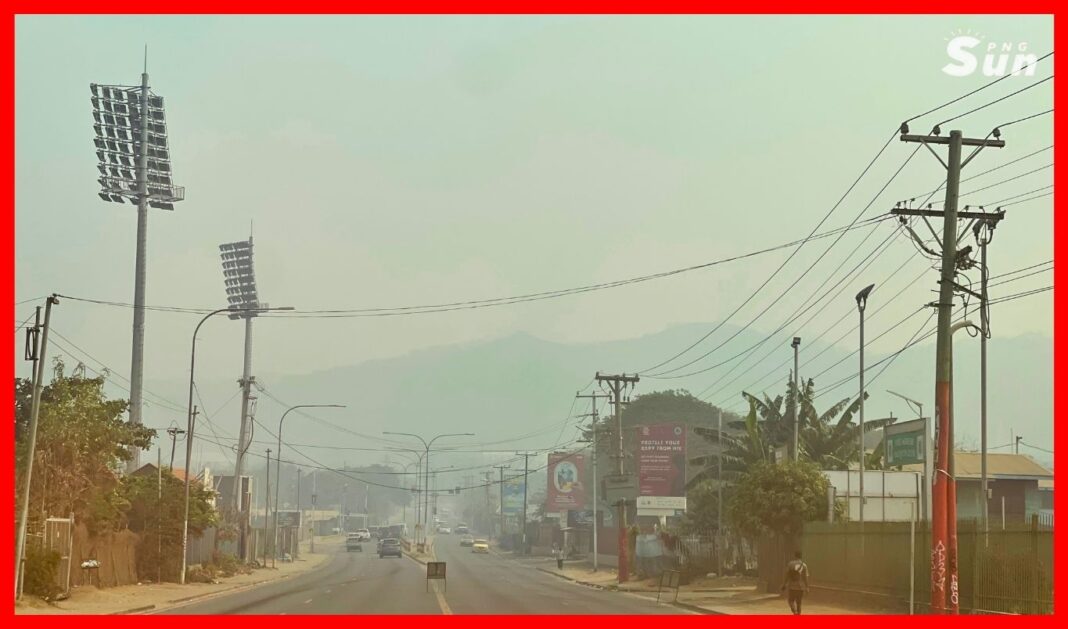

Smoky-looking skies (Haze) are re-appearing all over Port Moresby yesterday.
Everyone wonders what are its causes and effects.
National Weather Services was quoted on a local newspaper report that it was caused by airborne particles from bushfires in around PNG and Indonesia.
Related news: https://www.pnghauslain.com/harmful-haze-over-png-continues/
The National Weather Service (NWS) has warned residents to take precautions against possible respiratory health risks.
According to a report published by The National, NWS assistant director Kasis Inape said the haze could be associated with smoke from vegetation and forest fires, although further analysis is needed to establish its actual source.
Inape said smoke from bushfires could contain harmful pollutants, particularly fine particles that penetrate the lungs and potentially affect the health of people exposed to them.
He explained that prolonged dry weather during El Niño conditions could increase the risk of vegetation and forest fires in parts of PNG and Indonesia, generating smoke that could travel hundreds or thousands of kilometers under prevailing winds.
“While smoke from Indonesia is a possible contributor to the haze currently observed in Port Moresby, further analysis of satellite imagery, fire locations and prevailing wind patterns is required to establish its actual origin,” he said in the report.
Inape said the health risks depended on the concentration of pollutants in the atmosphere, and the length of time people were exposed.
He cautioned that without air-quality measurements, authorities could not determine whether the current haze contained harmful concentrations of smoke particles.
“Residents should remain cautious but need not be unnecessarily alarmed,” he said.
However, he warned that prolonged exposure to persistent or thickening haze could cause eye irritation, coughing, breathing difficulties and other respiratory problems.
Young children, elderly people, pregnant women and those with asthma or existing heart and lung conditions were particularly vulnerable to the effects of smoke pollution.
Inape advised residents to reduce prolonged outdoor activities, especially when the haze became dense or carried a strong smoky smell.
People were also advised to keep windows and doors closed during periods of heavy smoke and avoid strenuous outdoor exercise when air quality appeared poor.
Residents who could not avoid exposure to heavy smoke were encouraged to use well-fitting masks and take extra precautions to protect vulnerable family members.
Those experiencing persistent coughing were advised to seek medical attention.