
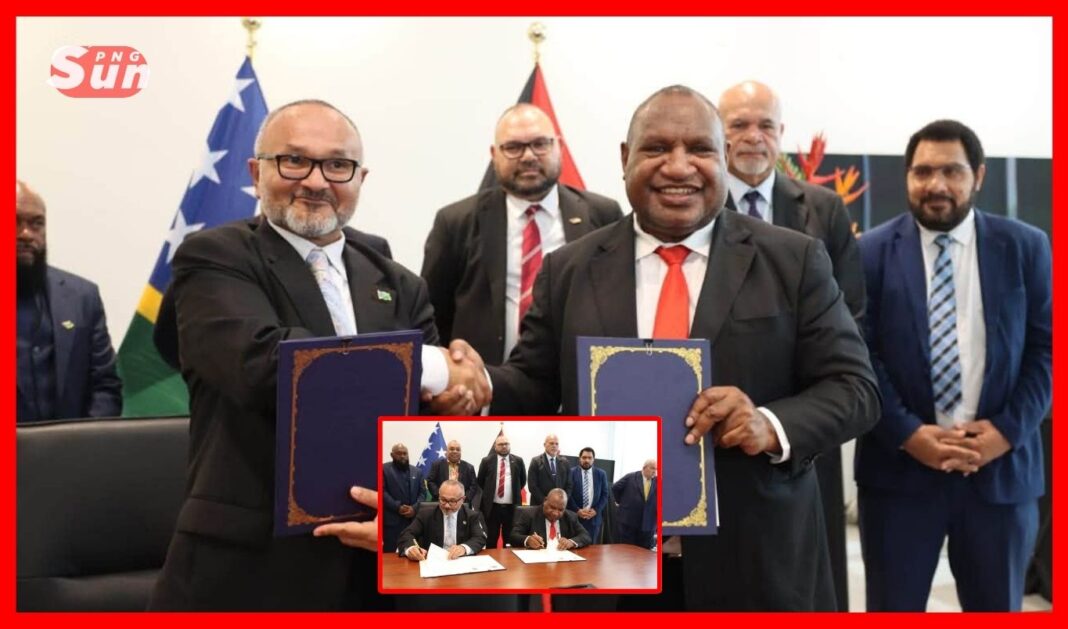

PNG Prime Minister James Marape has offered his country’s mining policy and resource governance expertise to support Solomon Islands’ resource development while welcoming opportunities for PNG mining companies to invest in future projects.
During bilateral talks in Port Moresby with Solomon Islands Prime Minister Matthew Wale last Friday, PM Marape said Papua New Guinea had gained valuable lessons through decades of resource development and was prepared to assist Solomon Islands establish a modern mining regime that delivers stronger returns to its people while remaining attractive to investors.
PM Marape in a statement said both countries, located along the Pacific Ring of Fire, possessed significant mineral potential and stressed the importance of designing resource laws that secure long-term national benefits.
“As you develop your mining laws, it is important to get them right from the beginning,” he said.
“Papua New Guinea is still refining its own resource laws, but we have accumulated decades of experience.”
“We are prepared to send our resource lawyers and technical experts to work with your team so that together we can develop policies that deliver long-term benefits for our people.”
PM Marape said Papua New Guinea’s resource policy aims to ensure the State receives at least 55 per cent of total economic benefits from major mining projects through a combination of taxation, equity participation, royalties and other fiscal measures.
“Our objective is simple. Investors must make a reasonable return because they bring capital, technology and expertise. At the same time, the country that owns the resources must also receive a fair and equitable share of the benefits.”
He emphasized that equity participation differs from taxation because it gives governments and landowners direct ownership and influence over project decisions and long-term value creation.
PM Marape pointed to Papua New Guinea’s experience with the Panguna Mine in Bougainville as a lesson in the consequences of excluding customary landowners from meaningful ownership and benefit-sharing arrangements.
“The Bougainville crisis remains a lasting reminder of what can happen when resource development is not perceived as fair by the people who own the land.
“Our biggest lesson is this: if you do not get the relationship with customary landowners right, the project will ultimately fail. Landowners must be central to any resource development policy.”
He said resource laws in both countries must reflect the reality that mineral deposits are largely located on customary land and ensure fair distribution of benefits.
PM Marape said Papua New Guinea continued to pursue better outcomes from resource projects, citing the reopening of the Porgera Gold Mine where PNG interests negotiated a 51 per cent stake.
Prime Minister Wale, he said, had expressed interest in adopting a similar approach in Solomon Islands and invited Papua New Guinea mining companies to participate in future mining developments under a model where Solomon Islands would retain majority ownership.
PM Marape welcomed the invitation and said he had directed Kumul Minerals Holdings Limited and Ok Tedi Mining Limited to assess investment opportunities and engage with counterparts in Solomon Islands.
He also revealed that Papua New Guinea had received a similar invitation from France following his recent state visit, with discussions underway for potential participation in nickel developments in New Caledonia.
PM Marape said Papua New Guinea was entering a new phase where local mining companies were expanding beyond national borders after decades of hosting foreign investors.
He also encouraged Solomon Islands to establish strong local content policies to maximise employment, business participation and domestic value creation from future mining projects.
At the same time, PM Marape cautioned against imposing fiscal regimes that discourage investment.
“Resource investors are not charities. Governments must strike the right balance, so investors continue to achieve internationally competitive returns while resource-owning countries receive a substantially greater share of the overall benefits.”
He said Papua New Guinea remained committed to sharing its experience with Melanesian neighbors while creating regional investment partnerships that deliver greater long-term benefits from natural resources.