

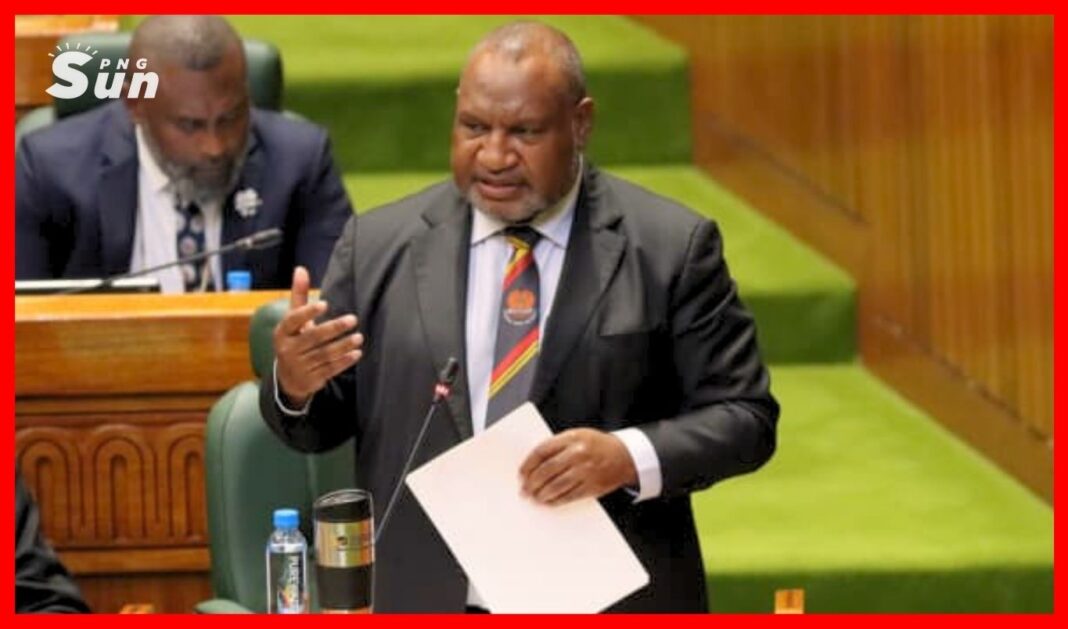

Prime Minister James Marape says the political future of Bougainville must be determined by Parliament after the 2019 referendum result was formally brought before the House yesterday.
He urged Members of Parliament not to rush their decision but to carefully consider the constitutional, political and long-term implications for both Bougainville and Papua New Guinea.
Speaking during the parliamentary debate on the Bougainville referendum on the floor of Parliament yesterday morning, Mr. Marape said the tabling of the result marked an important milestone in the peace process but was not the conclusion of the parliamentary process.
“The decision is now formally before this Parliament, and we must respect the process that has brought this decision into our Parliament,” Mr. Marape told Parliament.
He said Section 342 of the Constitution provides the pathway for Parliament to consider the referendum result.
“The outcome is not self-executing. It is this Parliament that must determine the way forward,” he said.
Mr. Marape said Parliament must now carefully examine the referendum result, the Joint Consultation Report and the Melanesian Framework before making its decision at a future sitting.
He said the Government did not intend to pre-empt Parliament’s deliberations and that every Member of Parliament should have sufficient time to study the relevant documents, seek clarification, consult their constituents and form an independent judgment.
“No member should be rushed into making such an important decision,” Mr Marape said.
“We’re allowing time for all members to peruse all documents, research matters of fact, see your country from the lens of Bougainville and see Bougainville from the lens of the rest of the country.”
Mr. Marape said Parliament could return to the matter at a future sitting, possibly in October, subject to further consultation and exchanges between the National Government and the Autonomous Bougainville Government.
He said the Government was considering dedicating one or two days for Members of Parliament and governors to speak at length before Parliament eventually makes its decision in accordance with the constitutional process.
“We will come back at a future sitting, possibly October, subject to consultation and exchange between the two governments, the National Government and the Autonomous Government,” he said.
The Prime Minister urged political leaders to read the Joint Consultation Report and the Melanesian Framework rather than relying solely on information provided by others.
“I want to ask all leaders, pick a report and read. Someone else telling you may be far from the truth. Read through the Melanesian Framework. Read through the Joint Consultation Report,” he said.
“Take it back to your assembly. Take it back to your DDAs. Process this. This is a serious matter.”
Mr. Marape said the documents would provide Members of Parliament with the information needed to make an informed decision on the future pathway.
He said there remained important constitutional, legal, political, economic and administrative issues requiring careful examination and thoughtful debate.
“Our objective must be to find a pathway that respects the referendum results, but equally complies with the Constitution, honours the Bougainville Peace Agreement and safeguards the long-term interests of both Bougainville and Papua New Guinea,” Mr. Marape said.
The Prime Minister said the Government’s role was to ensure that the matter was brought before Parliament in accordance with the constitutional process, while the final parliamentary decision must follow proper deliberation.
“When Parliament is eventually called upon to vote, each member must exercise their responsibility according to their conscience, their understanding of the Constitution and their national interests and Bougainville interests,” he said.
Mr. Marape also said that, despite serving as Prime Minister, he would have only one vote when Parliament is eventually called upon to make its decision.
“My standing as Prime Minister is reduced to just one vote on the floor of Parliament as a member of Tari,” he said.
Mr. Marape began his address by offering an apology to the people of Bougainville and calling for reconciliation as Papua New Guinea enters the next stage of the Bougainville political process.
Speaking after the national Repentance Day observance, he said he wanted, on behalf of Papua New Guinea’s 21 provinces, to seek forgiveness from the people of Bougainville for any offences committed during the country’s history.
“If we had offended you in any way, form or shape in the last 50 years we have been independent, or going 51 now, we want to say sorry,” he said.
Mr. Marape reflected on the Bougainville conflict, describing it as one of the most painful periods in Papua New Guinea’s history.
“Lives were lost, families were separated, communities endured immense hardship, especially in Bougainville,” he said.
He said the Bougainville Peace Agreement provided a pathway from conflict to reconciliation and that the referendum and subsequent consultations demonstrated that difficult political questions could be addressed through dialogue rather than conflict.
“The Bougainville Peace Agreement created a pathway from conflict to reconciliation,” he said.
“We must protect that achievement.”
Mr. Marape said the debate on the Bougainville referendum must be conducted with dignity, respect and maturity, regardless of individual views.
“Whatever our individual views may be, this Parliament debate must be conducted with dignity, respect and maturity,” he said.
“This is not simply a constitutional or political issue. It concerns the lives, hopes and futures of our people.”
He said the Bougainville issue had left an indelible imprint on Papua New Guinea’s history and required careful, informed and respectful consideration.
“This is a matter of profound national significance,” Mr. Marape said.
The Prime Minister said Parliament’s responsibility was to consider the issue from both the perspective of Bougainville and the wider interests of Papua New Guinea.
As Parliament prepares for further deliberations, Mr. Marape urged Members to approach the matter with patience, dialogue and respect for the Constitution and the Bougainville Peace Agreement.
The final outcome, he said, should emerge through Parliament’s constitutional process after Members have been given adequate time to study the documents and consider the implications of their decision for Bougainville and Papua New Guinea.